EVOGENIO®
- Evolutionäre Kunst
- Charles Robert Darwin
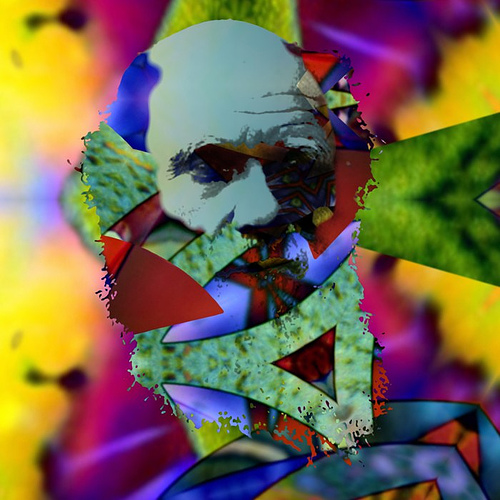
Ein Click auf das Portrait führt zur Population der Evolutionären Portraitkunst erstellt von Dr. Günter Bachelier
Charles Robert Darwin (* 12. Februar 1809 in The Mount (einem Teil von Shrewsbury), England; † 19. April 1882 in Downe) war ein britischer Naturforscher und gilt als einer der bedeutendsten Naturwissenschaftler überhaupt.
Charles Darwin begründete zusammen mit Alfred Russel Wallace die moderne Evolutionstheorie. Beide erkannten, dass die evolutive Entwicklung aller Organismen und ihre Aufspaltung in verschiedene Arten eine Folge der Anpassung an den Lebensraum durch Variation und natürliche Selektion ist. In Darwins am 24. November 1859 veröffentlichten Hauptwerk On the Origin of Species (Die Entstehung der Arten) stellte er seine Theorie zum ersten Mal einer breiteren Öffentlichkeit vor (erste deutsche Übersetzung 1860). Sie bildet die Grundlage der modernen Evolutionstheorie und stellte den entscheidenden Wendepunkt in der Geschichte der modernen Biologie dar.
Darwins Abstammungslehre ist auch unter dem heute veralteten Begriff
des Darwinismus bekannt. Sein offizielles botanisches
Autorenkürzel lautet „Darwin“.
Leben
Jugend und Ausbildung (1809–1831)
Darwin wurde in Shrewsbury, England als fünftes von sechs Kindern und als zweiter Sohn in einem Landstädtchen geboren. Die Eltern waren Robert und Susannah Darwin, seine Großväter der Kunstkeramiker Josiah Wedgwood sowie der Naturwissenschaftler Erasmus Darwin, der sich mit Fossilien beschäftigte und in seinem 1796 erschienenen Buch Zoonomia die Idee vertrat, die heute existierenden Lebewesen hätten sich aus gemeinsamen Vorfahren entwickelt. Schon als Junge befasste Charles sich mit der Naturgeschichte.
Darwin besuchte die Shrewsbury School for Boys, vor deren altem Gebäude im Stadtzentrum, das heute die Stadtbücherei beherbergt, er als Statue auf einem Stuhl sitzend thront. Nach der Schule studierte Darwin ab 1825 Medizin in Edinburgh. Dort wurde er von Robert Edmund Grant beeinflusst, einem Anhänger Lamarcks. Wegen seiner Abneigung gegen das Sezieren und die grausamen Zustände bei Operationen zur damaligen Zeit – die Narkose war noch nicht erfunden – brach er sein Studium 1827 ab.
Sein Vater schrieb ihn in Cambridge für Theologie ein, da er wegen des Studienabbruchs befürchtete, aus seinem Sohn könnte nichts werden. Er hoffte, dass Charles einmal Pfarrer werden würde. Das Theologiestudium war zur damaligen Zeit eine übliche Laufbahn für einen naturbegeisterten Menschen, ein Umstand, der sich später – nicht zuletzt durch Darwin selbst – ändern sollte.
In Cambridge studierte Darwin zwar gewissenhaft auch die theologische Literatur, besonders begeisterte ihn aber die Biologie. Er wurde von Wissenschaftlern wie William Whewell, Adam Sedgwick und John Stevens Henslow für die Naturwissenschaften, wie z. B. Geologie begeistert. Aber auch schon vorher sammelte er gerne Käfer, eine Leidenschaft, zu der er durch seinen Vetter William Darwin Fox kam. Darwin beendete sein Studium am Christ College der Universität Cambridge mit dem Examen.
Die Weltreise auf der Beagle (1831–1836)
Darwin wollte mit einigen Studienkollegen nach dem Abschluss des
Studiums Madeira
besuchen, aber dieser Plan wurde nicht verwirklicht. Henslow jedoch
empfahl ihn als Begleiter für Robert Fitzroy, den Kapitän der HMS Beagle,
die zu einer fünfjährigen Expedition (27. Dezember 1831 bis
zum 2.
Oktober 1836) aufbrechen sollte. Das eigentliche Ziel der Expedition
waren Patagonien und Feuerland
an der Südspitze Südamerikas, um dort die unter Parker King
in den
Jahren 1826 bis 1830 begonnenen kartographischen Messungen
fortzusetzen. Ebenso sollten die Küsten Chiles, Perus
und einiger Südseeinseln vermessen sowie chronometrische
Bestimmungen
der Erde durchgeführt werden. Anfang 1831 verbrachte Darwin einige
Wochen auf einer geologischen Exkursion mit Adam Sedgwick in Nord-Wales.
Abgesehen von ein paar Vorlesungen in Edinburgh waren dies bis dahin
seine einzigen geologischen Studien.
Am 27. Dezember 1831 stach die HMS Beagle nach mehreren durch schlechtes Wetter verunmöglichten Startversuchen von Devonport (Plymouth) aus in See. Die Reise führte über die Kapverden, Bahia und Rio de Janeiro im Juli 1832 nach Montevideo. Fast zwei Jahre sollte die Beagle im Gebiet zwischen dem Mündungsgebiet des La Plata, Kap Horn und den Falklandinseln Vermessungsarbeiten durchführen. Darwin nahm in dieser Zeit an fünf Landungsunternehmungen teil. Ab Mitte 1834 bis August 1835 führt Darwin Erkundungen in Chile, Peru und der Insel Chiloe durch, die Beagle erreicht schließlich die Galapagosinseln. Auf den Stationen dieser Reise werden insbesondere seine Begegnung mit den Indianern Feuerlands, die Fossilienfunde in Patagonien und die Vogelbeobachtungen auf Galapagos zu bestimmenden Faktoren seiner späteren wissenschaftlichen Arbeiten.
Seine Arbeit während der Expedition erlaubte es ihm, sowohl die geologischen Eigenschaften von Kontinent und Inseln wie auch eine Vielzahl von Lebewesen und Fossilien zu untersuchen. Die Fragen zu Flora und Fauna der besuchten Gebiete, die Darwin sich während der Fahrt stellte, waren der Ausgangspunkt für die Evolutionstheorie, die ihn später weltberühmt machen sollte.
Karriere und Anfänge der Theorie (1836–1839)
1836, nach seiner Rückkehr, analysierte Darwin die gesammelten Stücke und bemerkte Ähnlichkeiten zwischen Fossilien und noch lebenden Tieren in der gleichen geografischen Region. Insbesondere fiel ihm auf, dass jede Insel ihre eigenen Schildkröten- und Vogelarten hatte, die sich leicht voneinander in Aussehen, Ernährung usw. unterschieden, sonst aber recht ähnlich waren.
Besonders bei den Exemplaren der Galapagosinseln war das klar zu sehen. Darwin entwickelte die Theorie, dass z. B. all die verschiedenen Schildkrötenarten von einer einzigen Art abstammten und sich an die unterschiedlichen Lebensbedingungen der verschiedenen Inseln angepasst hatten.
Aber Darwin war auch ein Kind seiner Zeit und analysierte seine Funde seiner Reise auf der HMS Beagle im Lichte verschiedener theoretischer Einflüsse.
Paradoxerweise war für Darwins adaptionsbasierte Evolutionstheorie und seine Suche nach einem einfachen und unveränderlichen Evolutionsgesetz auch sein naturtheologisches Umfeld vorher in Cambridge und insbesondere der Einfluss von William Paleys Natural Theology bedeutsam (vgl. v. Sydow, 2005).
Weitere wichtige Schriften, die einen großen Einfluss auf Darwin hatten, waren Lyells Principles of Geology und Thomas Robert Malthus‘ Essay on the Principle of Population.
Malthus war der Meinung, dass die Bevölkerung schneller wächst als die Nahrungsmittelproduktion und deshalb durch Hungersnöte in ihrer Zahl begrenzt wird. Malthus war zu dem Schluss gekommen, dass die Bevölkerung in geometrischer Reihe (2, 4, 8, 16, …) ansteigt, die Ressourcen (Nahrungsmittel) jedoch nur in arithmetischer Reihe (2, 3, 4, 5, …). Die düstere Folge davon waren für Malthus Hungersnöte und Überbevölkerung.
Auf diesen Gedanken aufbauend formulierte Darwin seine Überlegungen zu Veränderung und Entwicklung der Arten in seinem Notebook on the Transmutation of Species. Im Juli 1837 notierte er in dieses Notizbuch unter der Überschrift "I think" auf Seite 36 seinen ersten evolutionären Stammbaum.
Heirat und Kinder
Darwin hatte sich dem Gedanken an eine Heirat in gewohnter wissenschaftlicher Weise genähert. Aus seinem Nachlass ist eine Liste erhalten, in der er in zwei Spalten Gründe notiert hatte, die für und gegen das Heiraten sprachen. Unter der Überschrift „Marry“ notierte er: „constant companion and a friend in old age … better than a dog anyhow,“ und unter „Not Marry“ stand unter anderem „less money for books“ und „terrible loss of time.“ Die positiven Überlegungen überwogen. Darwin heiratete am 27. Januar 1839 seine Cousine Emma Wedgwood (1808 - 1896).
Nach einigen Jahren in London zogen sie schließlich in das Down House in der kleinen Ortschaft Downe (Grafschaft Kent). Heute ist das Haus eine bedeutende Sehenswürdigkeit des Ortes. Es deutet einiges darauf hin, dass Darwins jüngster Sohn Charles mit einem Down-Syndrom (Trisomie 21) geboren wurde. Darwin beschrieb sein jüngstes Kind, bei dem auf einer Fotografie charakteristische Merkmale der Behinderung zu erkennen sind, mit den Worten: „Er ist klein für sein Alter und beim Laufen und Sprechen verzögert. Er hat eine außergewöhnlich liebe, zufriedene und fröhliche Art, aber ist geistig nicht sehr entwickelt.“ (vgl. Stensma, David P.: Blood, 15. March 2005, Volume 105, Number 6). Das Kind wurde geboren, als seine Mutter bereits 48 Jahre alt war. Dies spricht ebenfalls für die Annahme, dass Charles Darwin ein Junge mit Down-Syndrom war, denn dieses Syndrom tritt gehäuft auf, wenn die Mutter des Kindes schon im fortgeschritttenen Alter ist.
Charles Darwin hatte zehn Kinder, von denen drei früh verstarben. Er galt als liebevoller Vater, der seinen Kindern viel Zeit widmete. Darwins Kinder waren:
- William Erasmus Darwin, Bankier (* 27. Dezember 1839, † 1914)
- Anne Elizabeth Darwin (* 2. März 1841, † 23. April 1851)
- Mary Eleanor Darwin (* 23. September 1842, † 16. Oktober 1842)
- Henrietta Emma Darwin (* 25. September 1843, † 1929)
- Sir George Howard Darwin, Astronom und Mathematiker (* 9. Juli 1845, † 7. Dezember 1912)
- Elizabeth Darwin (* 8. Juli 1847, † 1926)
- Sir Francis Darwin, Botaniker (* 16. August 1848, † 1925)
- Major Leonard Darwin, Parlamentsabgeordneter (* 15. Januar 1850, † 1943)
- Sir Horace Darwin, Wissenschaftler (* 13. Mai 1851, † 1928)
- Charles Waring Darwin (* 6. Dezember 1856, † 28. Juni 1858)
Einer der Enkel von Charles Darwin war der Sportjournalist Bernard Darwin, einer seiner Urururenkel ist der Filmschauspieler Skandar Keynes.
Die Entstehung von Korallenriffen
1842 veröffentlichte Darwin die Schrift „Über den Bau und die Verbreitung der Korallen-Riffe“. Darwin erklärt die Entstehung der oft kreisähnlich angeordneten Riffe dadurch, dass auf einem Vulkan beim langsamen Absinken des Meeresgrundes zuletzt nur noch um seinen Krater herum Korallen wachsen – denn diese können nur in einer bestimmten Tiefe überleben. Während der Vulkan immer weiter absinkt, wachsen die Korallen allmählich in den Tiefenbereich unter der Wasseroberfläche hinein, in dem sie sich wohlfühlen, so dass das ganze Atoll auch dann noch an der Meeresoberfläche bleibt, wenn der Berg, der es trägt, für das Auge schon ganz verschwunden ist. Dieses Werk begründete Darwins Ruf als Naturwissenschaftler. Darwin folgt in diesem Werk erstmalig dem Gedanken des Aktualismus und der Historisierung der Natur. Beides wird ihn auch in der Entstehung der Arten bis zu seiner letzten Arbeit über die Bildung des Ackerbodens nicht mehr verlassen: kleine auch heute beobachtbare Änderungen führen in großen Zeiträumen zu großen Änderungen.
Entwicklung der Theorie (1839–1859)
Zwischen 1839 und 1843 wurde Darwins Zoology of the Voyage of H. M. S. Beagle in fünf Bänden veröffentlicht.
1842 schrieb Darwin seine Theorie in einem kurzen Entwurf nieder, aus dem er bis 1844 ein 240 Seiten umfassendes Essay entwickelte, eine erweiterte Version seiner früheren Ideen über die natürliche Selektion. Aus Sorge vor der Reaktion, insbesondere der von Seiten der Kirche, schreckte Darwin in den folgenden zwanzig Jahren vor einer Veröffentlichung jedoch zurück. Zwischen 1844 und 1858 modifizierte er mehrfach einige Kleinigkeiten, ohne seine Gedanken jedoch je zu veröffentlichen.
Schon seit längerer Zeit stand Darwin im lockeren Briefwechsel mit Alfred Russel Wallace, der um 1858 in Ternate weilte. Dieser hatte schon 1855 in einem – leider wenig beachteten – Aufsatz mit dem Titel „On the Law wich has regulated the introduction of New Species“ die Kontinuität der Arten „in Raum und Zeit“ erkannt und dadurch die Aufmerksamkeit von Lyell und Darwin erregt. Wallace sandte ihm aus Ternate das Essay „On the Tendency of Varieties to depart indefinitely from the Original Type“, in dem er alle Prinzipien der Adaption durch Variation und Auslese („struggle for existence“) darlegte, die seiner Meinung nach zur Evolution notwendig seien. Darwin sah sich darauf zur Veröffentlichung seines geheimen Manuskriptes gedrängt. Er entschloss sich, statt des ursprünglich geplanten mehrbändigen Monumentalwerks nur ein einzelnes Buch herauszubringen.
Veröffentlichung der Evolutionstheorie (1858)
Am 1. Juli 1858 wurde Darwins Schrift Über die Entstehung der Arten im Thier- und Pflanzen-Reich durch natürliche Züchtung, oder Erhaltung der vervollkommneten Rassen im Kampfe um's Daseyn vor der Königlichen Linné-Gesellschaft verlesen, am gleichen Tag wie auch eine Schrift von Alfred Russel Wallace, der zwar deutlich später, aber unabhängig von Darwin, eine ähnliche Theorie entwickelt hatte.
Darwins Buch über den Ursprung der Arten, mit genau dem gleichen Titel wie die Vorlesung, wurde ein Jahr später veröffentlicht und stieß auf so großes Interesse, dass die Bestände des Verlags schon am ersten Tag ganz an die Buchläden verkauft waren.
In seinen späteren Büchern The Variation of Animals and Plants Under Domestication (1868), The Descent of Man, and Selection in Relation to Sex (1871) und The Expression of Emotions in Animals and Man (1872) führte Darwin viele Themen weiter aus, die er in 'Ursprung der Arten' vorgestellt hatte.
Reaktionen (1858–1882)
Die gesamte erste Auflage von The Origin of Species war innerhalb eines Tages ausverkauft. Trotz einiger anfänglicher Kritik wurde Darwins Arbeit in der wissenschaftlichen Welt anerkannt. 1875 veröffentlichte er sein Werk Insectivorous plants, mit dem er bewies, dass zahlreiche Pflanzen fleischfressend sind. Damit überwand er Carl von Linnés Dogma von der Widernatürlichkeit solcher Arten. Insectivorous plants ist bis heute ein Standardwerk zum Thema.
Tod und Nachleben (ab 1882)
Darwin starb am 19. April 1882 im Alter von 73 Jahren in Downe und wurde am 26. April in der Westminster Abbey bestattet.
Im Jahr 2000 wurde sein Bild auf die britische 10-Pfund-Note gedruckt und ersetzte damit Charles Dickens. Ein Grund soll gewesen sein, dass Darwins Bart nur schwer zu fälschen ist.
Mitte 2006 verstarb seine Schildkröte Harriet im Alter von 176 Jahren im Australia-Zoo im nordöstlichen australischen Bundesstaat Queensland. Darwin hatte sie selber 1835 von den Galapagosinseln mitgebracht, als diese vermutlich fünf Jahre alt war. Sie wurde zunächst Harry genannt, da man ihr wahres Geschlecht erst in den 1950ern erkannte. Sie wog am Schluss 150 kg und starb an Herzversagen.
Ehrungen
1839 wurde Darwin Mitglied der Royal Society, die ihn 1853 mit der Royal Medal auszeichnete. 1878 wurde er Mitglied in der französischen Académie des sciences.
Eine von der britischen Royal Society verliehene Auszeichnung für Wissenschaftler, die wichtige Beiträge im Bereich der Biologie geleistet haben, ist nach ihm Darwin-Medaille benannt.
Gedenktag
Jährlich am 12. Februar, Darwins Geburtstag, wird der Darwin-Tag gefeiert. Durch diesen Gedenktag soll an Darwins Werk erinnert und die Wissenschaft gefördert werden. Der Gedenktag wird hauptsächlich von humanistischen und/oder atheistischen Organisationen begangen.
Werk
Darwin vertrat vier Hypothesen, auf denen seine Evolutionstheorie aufgebaut ist:
- Veränderlichkeit: Die Welt ist nicht unveränderlich, sondern unterliegt einem kontinuierlichen Veränderungsprozess.
- Gemeinsame Abstammung: Alle Organismen stammen durch einen kontinuierlichen Verzweigungsprozess von gemeinsamen Vorfahren ab.
- Allmählichkeit der Evolution: Die Evolution erfolgt stets allmählich und nicht in Sprüngen.
- Natürliche Auslese: Die am besten angepassten Individuen zeugen am meisten Nachkommen, dadurch werden schlechter Angepasste verdrängt. Abänderungen, welche weder vorteilhaft noch von Nachteil sind, werden von diesem Prozess nicht berührt.
Diese Hypothesen beruhen auf drei Schlussfolgerungen aus folgenden Annahmen:
- Alle Arten besitzen eine derart potentielle Fruchtbarkeit, dass ihre Populationsgröße exponentiell anwachsen würde, wenn alle Individuen sich wieder erfolgreich fortpflanzen würden.
- Eine Population ist normalerweise weitgehend stabil.
- Die natürlichen Ressourcen sind begrenzt, aber relativ konstant.
- Zwei Individuen einer Art sind niemals gleich. Damit ergibt sich eine große Variabilität innerhalb einer Population.
- Ein großer Teil der Variabilität ist erblich.
Folgerungen:
- 4.1 Aus den Tatsachen ergibt sich, dass unter den Individuen einer Population ein Kampf ums Dasein stattfinden muss und nur ein Teil der Nachkommen überleben kann.
- 4.2 Das Überleben im Kampf ums Dasein erfolgt nicht zufällig, sondern hängt zum großen Teil von der erblichen Konstitution der überlebenden Individuen ab. Dieses ungleiche Überleben ist ein natürlicher Ausleseprozess.
- 4.3 Im Verlauf von Generationen führt die natürliche Auslese zur allmählichen Abänderung der Population, d. h. zur Evolution und Erzeugung neuer Arten.
Da Darwin seine Vorstellungen mit dem sich damals entwickelnden Sozialdarwinismus auch auf soziale Konflikte übertragen sah, versuchte er sich davon in einigen Spätwerken zu distanzieren. So betont er in Descent of Man: Moralische Fähigkeiten sind höher einzustufen als intellektuelle. Moralische Eigenschaften erleben einen direkten oder indirekten Fortschritt weit mehr durch das Einwirken von Gewohnheit, Vernunft, Anleitung, Religion etc. denn durch die natürliche Auslese.
Werke
- 1839 Narrative of the Surveying Voyages of Her Majesty’s Ships ‘Adventure’ and ‘Beagle’ between the years 1826 and 1836, describing their examination of the Southern shores of South America, and the ‘Beagle’s’ circumnavigation of the globe; deutsch: 2006, Die Fahrt der Beagle, Hamburg, Marebuchverlag; ISBN 3936384959
- 1842 The Structure and Distribution of Coral Reefs. Being the First Part of the Geology of the Voyage of the Beagle; deutsch: Über den Bau und die Verbreitung der Korallen-Riffe
- 1842-46 Geological observations on Coral Reefs, Volcanic Islands, and on South America: being the Geology of the Voyage of the Beagle, under the Command of Capt. FitzRoy, during the Years 1832-36
- 1845 Journal of Researches into the Natural History and Geology of the countries visited during the Voyage of H.M.S. ‘Beagle’ round the world, under the command of Captain Fitz-Roy, R.N.; deutsch:
- 1851 A Monograph of the Fossil Lepadidae; or, Pedunculated Cirripedes of Great Britain
- 1851 A Monograph of the Sub-class Cirripedia, with Figures of all the Species. The Lepadidae; or, Pedunculated Cirripedes
- 1854 A Monograph on the Fossil Balanidæ and Verrucidæ of Great Britain
- 1854 Monograph of the Sub-class Cirripedia, with Figures of all the Species. The Balanidae (or Sessile Cirripedes); the Verrucidae, etc.
- 1859 Die Entstehung der Arten (Text auf wikisource); Original: On the Origin of Species by Means of Natural Selection, or the Preservation of Favoured Races in the Struggle for Life, bei John Murray, London; deutsch: Über die Entstehung der Arten im Thier- und Pflanzen-Reich durch natürliche Züchtung, oder Erhaltung der vervollkommneten Rassen im Kampfe um's Daseyn, Nachw. von G. Heberer, Übersetzt von C.W. Neumannn; erst 1872 zur 6. Auflage wurde der Titel gestrafft zum The Origin of Species. 693 Seiten, Stuttgart, Reclam-Verlag, 1986 - ISBN 3-1500-3071-4
- 1862 On the various contrivances by which British and foreign orchids are fertilised by insects Dt.: „Die verschiedenen Einrichtungen durch welche Orchideen von Insecten befruchtet werden“ (1877)
- 1868 The variation of animals and plants under domestication
- 1871 Die Abstammung des Menschen; Original: The descent of man and selection in relation to sex; deutsch: 2005, Abstammung des Menschen; Paderborn: Voltmedia, ISBN 3937229868
- 1872 The expression of the emotions in man and animals; deutsch: 2000, Der Ausdruck der Gemütsbewegungen bei dem Menschen und den Tieren, Frankfurt, ISBN 3-8218-4188-5
- 1875 The movements and habits of climbing plants Dt.: „Die Bewegungen und Lebensweise der kletternden Pflanzen“
- 1875 Insektenfressende Pflanzen (Text auf wikisource); Original: Insectivorous plants
- 1876 The effects of cross and self-fertilisation in the vegetable kingdom Dt.: „Die Wirkungen der Kreuz- und Selbst-Befruchtung im Pflanzenreich“
- 1877 A biographical sketch of an infant, Mind, 2, 285–294
- 1877 The different forms of flowers on plants of the same species Dt.: „Die verschiedenen Blüthenformen an Pflanzen der nämlichen Art“
- 1880 The power of movement in plants; Deutsch: Das Bewegungsvermögen der Pflanzen
- 1881 The formation of vegetable mould, through the action of worms; Deutsch: Die Bildung der Ackererde durch die Tätigkeit der Würmer
- 1886 Über die Wege der Hummel-Männchen (Text auf wikisource) aus Gesammelte kleinere Schriften von Charles Darwin
Literatur
- Charles Darwin: Gesammelte Werke. Nach der Übers. aus dem Englischen von: J. Victor Carus, Zweitausendeins, Frankfurt am Main 2006, ISBN 3-86150-773-0.
- Eve-Marie Engels: Charles Darwin. C.H. Beck, München 2007, ISBN 978-3-406-54763-8.
- Johannes Hemleben: Charles Darwin. Rowohlt, Reinbek 2004, ISBN 3-499-50137-6.
- Irving Stone: Der Schöpfung wunderbare Wege. Das Leben des Charles Darwin (Roman). (1980, dt. 1981). Rowohlt, Reinbek 2005, ISBN 3-499-23864-0.
- Franz M. Wuketits: Darwin und der Darwinismus. München 2005, ISBN 3-406-50881-2.
- Franz M. Wuketits: Charles Darwin. Der stille Revolutionär, Piper, München und Zürich 1987, ISBN 3-492-15261-9.
- Jörg Blech, Rafaela von Bredow, Johann Grolle: Darwins Werk, Gottes Beitrag. Der Spiegel 52/2005, S. 136–147 (2005), ISSN 0038-7452. (Hier geht es um Amerikas konservative Haltung gegenüber den Erkenntnissen Darwins).
- Momme von Sydow: Darwin – A Christian Undermining Christianity? On Self-Undermining Dynamics of Ideas Between Belief and Science. In: David M. Knight, Matthew D. Eddy. Science and Beliefs: From Natural Philosophy to Natural Science, 1700–1900 (S. 141–156). Ashgate, Burlington 2005, ISBN 0-7546-3996-7.
Eine überraschende Deutung zu Darwins Entdeckung der Evolutionstheorie findet sich in:
- Zimmermann, Martin: Der Kampf ums Dasein – Charles Darwin entwickelt die Theorie der Evolution. In: Weltgeschichte in Geschichten. Würzburg 2004, ISBN 3-401-05442-2, S. 115–123.
Sonstiges
- Peter Nichols: Evolution's Captain. 2003 (dt.: Darwins Kapitän. Europa Verlag, Hamburg 2004, ISBN 3-203-80526-X).
- Julia Voss: Darwins Bilder. Ansichten der Evolutionstheorie 1837-1874. Fischer Taschenbuch Verlag, Frankfurt am Main 2007, ISBN 978-3-596-17627-4.
Weblinks
- The Complete Work of Charles Darwin Online (Gesamtedition der Universität Cambridge, auf Englisch)
- Literatur von und über Charles Darwin im Katalog der Deutschen Nationalbibliothek
- Autoreintrag und Liste der beschriebenen Pflanzennamen für Charles Darwin bei IPNI.
- Autobiographie
- The Darwin Digital Library of Evolution beim American Museum of Natural History
- Die Entstehung der Arten (Volltext, Ausgabe von 1884)
- Die Entstehung der Arten (Volltext, Ausgabe von 1859)
- Die Abstammung des Menschen (Faksimile, Ausgabe von 1875)
- Knowing Darwin (engl., informativ)
- The Darwin Correspondence Project (University of Cambridge), 5.000 Briefe an und von Charles Darwin bis 1865
- Werke von Charles Darwin als gemeinfreie Online-Texte beim Project Gutenberg
- Friedrich Wilhelm Bautz: Charles Darwin. In: Biographisch-Bibliographisches Kirchenlexikon (BBKL). Bd. 1, Hamm 1975, ISBN 3-88309-013-1, Sp. 1227–1229.
- Informationen zum Darwin-Tag (englisch)
Quelle (04.2008): http://de.wikipedia.org/wiki/Charles_Darwin
Charles Robert Darwin (12 February 1809 – 19 April 1882) was an English naturalist,[I] eminent as a collector and geologist, who proposed and provided scientific evidence that all species of life have evolved over time from common ancestors through the process he called natural selection.[1] The fact that evolution occurs became accepted by the scientific community and the general public in his lifetime, while his theory of natural selection came to be widely seen as the primary explanation of the process of evolution in the 1930s,[1] and now forms the basis of modern evolutionary theory. In modified form, Darwin’s scientific discovery remains the foundation of biology, as it provides a unifying logical explanation for the diversity of life.[2]
Darwin developed his interest in natural history while studying first medicine at Edinburgh University, then theology at Cambridge.[3] His five-year voyage on the Beagle established him as a geologist whose observations and theories supported Charles Lyell’s uniformitarian ideas, and publication of his journal of the voyage made him famous as a popular author. Puzzled by the geographical distribution of wildlife and fossils he collected on the voyage, Darwin investigated the transmutation of species and conceived his theory of natural selection in 1838.[4] Although he discussed his ideas with several naturalists, he needed time for extensive research and his geological work had priority.[5] He was writing up his theory in 1858 when Alfred Russel Wallace sent him an essay which described a similar theory, prompting immediate joint publication of both of their theories.[6]
His 1859 book On the Origin of Species established evolution by common descent as the dominant scientific explanation of diversification in nature. He examined human evolution and sexual selection in The Descent of Man, and Selection in Relation to Sex, followed by The Expression of the Emotions in Man and Animals. His research on plants was published in a series of books, and in his final book, he examined earthworms and their effect on soil.[7]
In recognition of Darwin’s pre-eminence, he was buried in Westminster Abbey, close to John Herschel and Isaac Newton.[8]
Biography
Early life
-
For more details on this topic, see Charles Darwin's education.
Charles Robert Darwin was born in Shrewsbury, Shropshire, England on 12 February 1809 at his family home, the Mount.[9] He was the fifth of six children of wealthy society doctor and financier Robert Darwin, and Susannah Darwin (née Wedgwood). He was the grandson of Erasmus Darwin on his father’s side, and of Josiah Wedgwood on his mother’s side. Both families were largely Unitarian, though the Wedgwoods were adopting Anglicanism. Robert Darwin, himself quietly a freethinker, made a nod toward convention by having baby Charles baptised in the Anglican Church. Nonetheless, Charles and his siblings attended the Unitarian chapel with their mother, and in 1817, Charles joined the day school, run by its preacher. In July of that year, when Charles was eight years old, his mother died. From September 1818, he attended the nearby Anglican Shrewsbury School as a boarder.[10]
Darwin spent the summer of 1825 as an apprentice doctor, helping his father treat the poor of Shropshire. In the autumn, he went to the University of Edinburgh, Scotland, to study medicine, but he was revolted by the brutality of surgery and neglected his medical studies. He learned taxidermy from John Edmonstone, a freed black slave who told him exciting tales of the South American rainforest. Later, in The Descent of Man, he used this experience as evidence that “Negroes and Europeans” were closely related despite superficial differences in appearance.[11]
In Darwin’s second year, he joined the Plinian Society, a student group interested in natural history.[12] He became a keen pupil of Robert Edmund Grant, a proponent of Jean-Baptiste Lamarck’s theory of evolution by acquired characteristics, which Charles’s grandfather Erasmus had also advocated. On the shores of the Firth of Forth, Darwin joined in Grant’s investigations of the life cycle of marine animals. These studies found evidence for homology, the radical theory that all animals have similar organs which differ only in complexity, thus showing common descent.[13] In March 1827, Darwin made a presentation to the Plinian of his own discovery that the black spores often found in oyster shells were the eggs of a skate leech.[14] He also sat in on Robert Jameson’s natural history course, learning about stratigraphic geology, receiving training in classifying plants, and assisting with work on the extensive collections of the University Museum, one of the largest museums in Europe at the time.[15]
In 1827, his father, unhappy at his younger son’s lack of progress, shrewdly enrolled him in a Bachelor of Arts course at Christ’s College, Cambridge to qualify as a clergyman, expecting him to get a good income as an Anglican parson.[16] However, Darwin preferred riding and shooting to studying.[17] Along with his cousin William Darwin Fox, he became engrossed in the craze at the time for the competitive collecting of beetles.[18] Fox introduced him to the Reverend John Stevens Henslow, professor of botany, for expert advice on beetles. Darwin subsequently joined Henslow’s natural history course and became his favourite pupil, known to the dons as “the man who walks with Henslow”.[19][20] When exams drew near, Darwin focused on his studies and received private instruction from Henslow. Darwin was particularly enthusiastic about the writings of William Paley, including the argument for divine design in nature.[21] It has been argued that Darwin’s enthusiasm for Paley’s religious adaptationism paradoxically played a role even later, when Darwin formulated his theory of natural selection.[22] In his finals in January 1831, he performed well in theology and, having scraped through in classics, mathematics and physics, came tenth out of a pass list of 178.[23]
Residential requirements kept Darwin at Cambridge until June. Following Henslow’s example and advice, he was in no rush to take Holy Orders. Inspired by Alexander von Humboldt’s Personal Narrative, he planned to visit Tenerife with some classmates after graduation to study natural history in the tropics. To prepare himself, Darwin joined the geology course of the Reverend Adam Sedgwick and, in the summer, went with him to assist in mapping strata in Wales.[24] After a fortnight with student friends at Barmouth, he returned home to find a letter from Henslow recommending Darwin as a suitable (if unfinished) naturalist for the unpaid position of gentleman’s companion to Robert FitzRoy, the captain of HMS Beagle, which was to leave in four weeks on an expedition to chart the coastline of South America. His father objected to the planned two-year voyage, regarding it as a waste of time, but was persuaded by his brother-in-law, Josiah Wedgwood, to agree to his son’s participation.[25]
Journey of the Beagle
-
For more details on this topic, see Second voyage of HMS Beagle.

The Beagle survey took five years, two-thirds of which Darwin spent on land. He carefully noted a rich variety of geological features, fossils and living organisms, and methodically collected an enormous number of specimens, many of them new to science.[1] At intervals during the voyage he sent specimens to Cambridge together with letters about his findings, and these established his reputation as a naturalist. His extensive detailed notes showed his gift for theorising and formed the basis for his later work. The journal he originally wrote for his family, published as The Voyage of the Beagle, summarises his findings and provides social, political and anthropological insights into the wide range of people he met, both native and colonial.[26]
While on board the ship, Darwin suffered badly from seasickness.[27] In October 1833 he caught a fever in Argentina, and in July 1834, while returning from the Andes down to Valparaíso, he fell ill and spent a month in bed.[28]
Before they set out, FitzRoy gave Darwin the first volume of Charles Lyell’s Principles of Geology, which explained landforms as the outcome of gradual processes over huge periods of time.[II] On their first stop ashore at St Jago, Darwin found that a white band high in the volcanic rock cliffs consisted of baked coral fragments and shells. This matched Lyell’s concept of land slowly rising or falling, giving Darwin a new insight into the geological history of the island which inspired him to think of writing a book on geology.[29] He went on to make many more discoveries, some of them particularly dramatic.[1] He saw stepped plains of shingle and seashells in Patagonia as raised beaches, and after experiencing an earthquake in Chile saw mussel-beds stranded above high tide showing that the land had just been raised. High in the Andes he saw several fossil trees that had grown on a sand beach, with seashells nearby. He theorised that coral atolls form on sinking volcanic mountains, and confirmed this when the Beagle surveyed the Cocos (Keeling) Islands.[30]
In South America, Darwin found and excavated rare fossils of gigantic extinct mammals in strata with modern seashells, indicating recent extinction and no change in climate or signs of catastrophe. Though he correctly identified one as a Megatherium and fragments of armour reminded him of the local armadillo, he assumed his finds were related to African or European species and it was a revelation to him after the voyage when Richard Owen showed that they were closely related to living creatures exclusively found in the Americas.[31]
Lyell’s second volume, which argued against evolutionism and explained species distribution by “centres of creation”, was sent out to Darwin. He puzzled over all he saw, and his ideas went beyond Lyell.[32] In Argentina, he found that two types of rhea had separate but overlapping territories. On the Galápagos Islands he collected birds, and noted that mockingbirds differed depending on which island they came from.[33] He also heard that local Spaniards could tell from their appearance on which island tortoises originated, but thought the creatures had been imported by buccaneers.[34] In Australia, the marsupial rat-kangaroo and the platypus seemed so unusual that Darwin thought it was almost as though two distinct Creators had been at work.[35]
In Cape Town he and FitzRoy met John Herschel, who had recently written to Lyell about that “mystery of mysteries”, the origin of species. When organising his notes on the return journey, Darwin wrote that if his growing suspicions about the mockingbirds, the tortoises and the Falkland Island Fox were correct, “such facts undermine the stability of Species”, then cautiously added “would” before “undermine”.[36] He later wrote that such facts “seemed to me to throw some light on the origin of species”.[37]
Three natives who had been taken from Tierra del Fuego on the Beagle’s previous voyage were taken back there to become missionaries. They had become “civilised” in England over the previous two years, yet their relatives appeared to Darwin to be “miserable, degraded savages”.[38] A year on, the mission had been abandoned and only Jemmy Button spoke with them to say he preferred his harsh previous way of life and did not want to return to England. Because of this experience, Darwin came to think that humans were not as far removed from animals as his friends then believed, and saw differences as relating to cultural advances towards civilisation rather than being racial. He detested the slavery he saw elsewhere in South America, and was saddened by the effects of European settlement on Aborigines in Australia and Maori in New Zealand.[39]
Captain FitzRoy was committed to writing the official Narrative of the Beagle voyages, and near the end of the voyage, he read Darwin’s diary and asked him to rewrite this Journal to provide the third volume, on natural history.[40]
Inception of Darwin’s evolutionary theory
-
For more details on this topic, see Inception of Darwin's theory.
While Darwin was still on the voyage, Henslow fostered his former pupil’s reputation by giving selected naturalists access to the fossil specimens and a pamphlet of Darwin’s geological letters.[41] When the Beagle returned on 2 October 1836, Darwin was a celebrity in scientific circles. After visiting his home in Shrewsbury and seeing relatives, Darwin hurried to Cambridge to see Henslow, who advised on finding naturalists available to describe and catalogue the collections, and agreed to take on the botanical specimens. Darwin’s father organised investments, enabling his son to be a self-funded gentleman scientist, and an excited Darwin went round the London institutions being fêted and seeking experts to describe the collections. Zoologists had a huge backlog of work, and there was a danger of specimens just being left in storage.[42]
An eager Charles Lyell met Darwin for the first time on 29 October and soon introduced him to the up-and-coming anatomist Richard Owen, who had the facilities of the Royal College of Surgeons at his disposal to work on the fossil bones collected by Darwin. Owen’s surprising results included gigantic sloths, a hippopotamus-like skull from the extinct rodent Toxodon, and armour fragments from a huge extinct armadillo (Glyptodon), as Darwin had initially surmised.[43] The fossil creatures were unrelated to African animals, but closely related to living species in South America.[44]
In mid-December, Darwin moved to Cambridge to organise work on his collections and rewrite his Journal.[45] He wrote his first paper, showing that the South American landmass was slowly rising, and with Lyell’s enthusiastic backing read it to the Geological Society of London on 4 January 1837. On the same day, he presented his mammal and bird specimens to the Zoological Society. The ornithologist John Gould soon revealed that the Galapagos birds that Darwin had thought a mixture of blackbirds, “gros-beaks” and finches, were, in fact, twelve separate species of finches. On 17 February 1837, Darwin was elected to the Council of the Geographical Society, and in his presidential address, Lyell presented Owen’s findings on Darwin’s fossils, stressing geographical continuity of species as supporting his uniformitarian ideas.[46]
On 6 March 1837, Darwin moved to London to be close to this work, and joined the social whirl around scientists and savants such as Charles Babbage, who thought that God preordained life by natural laws rather than ad hoc miraculous creations. Darwin lived near his freethinking brother Erasmus, who was part of this Whig circle and whose close friend the writer Harriet Martineau promoted the ideas of Thomas Malthus underlying the Whig “Poor Law reforms” aimed at discouraging the poor from breeding beyond available food supplies. John Herschel’s question on the origin of species was widely discussed. Medical men even joined Grant in endorsing transmutation of species, but to Darwin’s scientist friends such radical heresy attacked the divine basis of the social order already under threat from recession and riots.[47]
Gould now revealed that the Galapagos mockingbirds from different islands were separate species, not just varieties, and the “wrens” were yet another species of finches. Darwin had not kept track of which islands the finch specimens were from, but found information from the notes of others on the Beagle, including FitzRoy, who had more carefully recorded their own collections. The zoologist Thomas Bell showed that the Galápagos tortoises were native to the islands. By mid-March, Darwin was convinced that creatures arriving in the islands had become altered in some way to form new species on the different islands, and investigated transmutation while noting his speculations in his “Red Notebook” which he had begun on the Beagle. In mid-July, he began his secret “B” notebook on transmutation, and on page 36 wrote “I think” above his first sketch of an evolutionary tree.[48]
Overwork, illness, and marriage
As well as launching into this intensive study of transmutation, Darwin became mired in more work. While still rewriting his Journal, he took on editing and publishing the expert reports on his collections, and with Henslow’s help obtained a Treasury grant of £1,000 to sponsor this multi-volume Zoology of the Voyage of H.M.S. Beagle. He agreed to unrealistic dates for this and for a book on South American Geology supporting Lyell’s ideas. Darwin finished writing his Journal around 20 June 1837 just as Queen Victoria came to the throne, but then had its proofs to correct.[49]
Darwin’s health suffered from the pressure. On 20 September 1837, he had “palpitations of the heart”. On doctor’s advice that a month of recuperation was needed, he went to Shrewsbury then on to visit his Wedgwood relatives at Maer Hall, but found them too eager for tales of his travels to give him much rest. His charming, intelligent, and cultured cousin Emma Wedgwood, nine months older than Darwin, was nursing his invalid aunt. His uncle Jos pointed out an area of ground where cinders had disappeared under loam and suggested that this might have been the work of earthworms. This inspired a talk which Darwin gave to the Geological Society on 1 November, the first demonstration of the role of earthworms in soil formation.[50]
William Whewell pushed Darwin to take on the duties of Secretary of the Geological Society. After first declining this extra work, he accepted the post in March 1838.[51] Despite the grind of writing and editing the Beagle reports, remarkable progress was made on transmutation. Darwin took every opportunity to question expert naturalists and, unconventionally, people with practical experience such as farmers and pigeon fanciers.[1][52] Over time his research drew on information from his relatives and children, the family butler, neighbours, colonists and former shipmates.[53] He included mankind in his speculations from the outset, and on seeing an ape in the zoo on 28 March 1838 noted its child-like behaviour.[54]
The strain took its toll, and by June he was being laid up for days on end with stomach problems, headaches and heart symptoms.[55] For the rest of his life, he was repeatedly incapacitated with episodes of stomach pains, vomiting, severe boils, palpitations, trembling and other symptoms, particularly during times of stress, such as when attending meetings or dealing with controversy over his theory. The cause of Darwin’s illness was unknown during his lifetime, and attempts at treatment had little success. Recent attempts at diagnosis have suggested Chagas disease caught from insect bites in South America, Ménière’s disease, or various psychological illnesses as possible causes, without any conclusive results.[56]
On 23 June 1838, he took a break from the pressure of work and went “geologising” in Scotland. He visited Glen Roy in glorious weather to see the parallel “roads” cut into the hillsides at three heights. He thought that these were marine raised beaches: they were later shown to have been shorelines of a proglacial lake.[57]
Fully recuperated, he returned to Shrewsbury in July. Used to jotting down daily notes on animal breeding, he scrawled rambling thoughts about career and prospects on two scraps of paper, one with columns headed “Marry” and “Not Marry”. Advantages included “constant companion and a friend in old age ... better than a dog anyhow”, against points such as “less money for books” and “terrible loss of time.”[58] Having decided in favour, he discussed it with his father, then went to visit Emma on 29 July 1838. He did not get around to proposing, but against his father’s advice he mentioned his ideas on transmutation.[59]
Continuing his research in London, Darwin’s wide reading now included “for amusement” the 6th edition of Malthus’s An Essay on the Principle of Population which calculates from the birth rate that human population could double every 25 years, but in practice growth is kept in check by death, disease, wars and famine.[1][60] Darwin was well prepared to see at once that this also applied to de Candolle’s “warring of the species” of plants and the struggle for existence among wildlife, explaining how numbers of a species kept roughly stable. As species always breed beyond available resources, favourable variations would make organisms better at surviving and passing the variations on to their offspring, while unfavourable variations would be lost. This would result in the formation of new species.[61] On 28 September 1838 he noted this insight, describing it as a kind of wedging, forcing adapted structures into gaps in the economy of nature as weaker structures were thrust out.[1] He now had a theory by which to work, and over the following months compared farmers picking the best breeding stock to a Malthusian Nature selecting from variants thrown up by “chance” so that “every part of [every] newly acquired structure is fully practised and perfected”, and thought this analogy “the most beautiful part of my theory”.[62]
On 11 November, he returned to Maer and proposed to Emma, once more telling her his ideas. She accepted, then in exchanges of loving letters she showed how she valued his openness, but her upbringing as a very devout Anglican led her to express fears that his lapses of faith could endanger her hopes to meet in the afterlife.[63] While he was house-hunting in London, bouts of illness continued and Emma wrote urging him to get some rest, almost prophetically remarking “So don’t be ill any more my dear Charley till I can be with you to nurse you.” He found what they called “Macaw Cottage” (because of its gaudy interiors) in Gower Street, then moved his “museum” in over Christmas. The marriage was arranged for 24 January 1839, but the Wedgwoods set the date back. On the 24th, Darwin was honoured by being elected as Fellow of the Royal Society.[64]
On 29 January 1839, Darwin and Emma Wedgwood were married at Maer in an Anglican ceremony arranged to suit the Unitarians, then immediately caught the train to London and their new home.[65]
Preparing the theory of natural selection for publication
-
For more details on this topic, see Development of Darwin's theory.
Darwin now had the framework of his theory of natural selection “by which to work”,[66] as his “prime hobby”.[67] His research subsequently included animal husbandry and extensive experiments with plants,[1] investigating many detailed ideas and finding evidence that species were not fixed to convince sceptical naturalists. For more than a decade this work was in the background to his main occupation, publication of the scientific results of the Beagle voyage.[68]
When FitzRoy’s Narrative was published in May 1839, Darwin’s Journal and Remarks (The Voyage of the Beagle) as the third volume was such a success that later that year it was published on its own.[69]
Early in 1842, Darwin sent a letter about his ideas to Lyell, who was dismayed that his ally now denied “seeing a beginning to each crop of species”. In May, Darwin’s book on coral reefs was published after more than three years of work, and he then wrote a “pencil sketch” of his theory.[70] To escape the pressures of London, the family moved to rural Down House in November.[71] On 11 January 1844 Darwin mentioned his theorising to the botanist Joseph Dalton Hooker, writing with melodramatic humour “it is like confessing a murder”.[72][73] To his relief, Hooker replied “There may in my opinion have been a series of productions on different spots, & also a gradual change of species. I shall be delighted to hear how you think that this change may have taken place, as no presently conceived opinions satisfy me on the subject.”[74]
By July, Darwin had expanded his “sketch” into a 230-page “Essay”, to be expanded with his research results if he died prematurely.[75] He was shocked in November to find many of his arguments anticipated in the anonymously published Vestiges of the Natural History of Creation, though it lacked any convincing explanation for transmutation. The book was amateurish and he scorned its geology and anatomy, but as a best-seller it widened middle-class interest in transmutation, paving the way for Darwin as well as reminding him of the need to counter all arguments.[76] Darwin completed his third geological book in 1846, and turned in relief to dissecting and classifying the barnacles he had collected, using his new ideas of common descent, and the anatomy he had learnt as Grant’s student.[77] In 1847, Hooker read the “Essay” and sent notes that provided Darwin with the calm critical feedback that he needed, but would not commit himself and questioned Darwin’s opposition to continuing acts of Creation.[78]
In an attempt to improve his chronic ill health, Darwin went in 1849 to Dr. James Gully’s Malvern spa and was surprised to find some benefit from hydrotherapy.[79] Then in 1851 his treasured daughter Annie fell ill, reawakening his fears that his illness might be hereditary. After a long series of crises, she died and Darwin’s faith in Christianity dwindled away.[80]
In eight years of work on barnacles (Cirripedia), Darwin found “homologies” that supported his theory by showing that slightly changed body parts could serve different functions to meet new conditions.[81] In 1853 it earned him the Royal Society’s Royal Medal, and it made his reputation as a biologist.[82] He resumed work on his theory of species in 1854, and in November realised that divergence in the character of descendants could be explained by them becoming adapted to “diversified places in the economy of nature”.[83]
Publication of the theory of natural selection
-
For more details on this topic, see Publication of Darwin's theory.
By the start of 1856, Darwin was investigating whether eggs and seeds could survive travel across seawater to spread species across oceans. Hooker increasingly doubted the traditional view that species were fixed, but their young friend Thomas Henry Huxley was firmly against evolution. Lyell was intrigued by Darwin’s speculations without realising their extent. When he read a paper by Alfred Russel Wallace on the Introduction of species, he saw similarities with Darwin’s thoughts and urged him to publish to establish precedence. Though Darwin saw no threat, he began work on a short paper. Finding answers to difficult questions held him up repeatedly, and he expanded his plans to a “big book on species” titled Natural Selection. He continued his researches, obtaining information and specimens from naturalists worldwide including Wallace who was working in Borneo. In December 1857, Darwin received a letter from Wallace asking if the book would examine human origins. He responded that he would avoid that subject, “so surrounded with prejudices”, while encouraging Wallace’s theorising and adding that “I go much further than you.”[84]
Darwin’s book was half way when, on 18 June 1858, he received a paper from Wallace describing natural selection. Shocked that he had been “forestalled”, Darwin sent it on to Lyell, as requested, and, though Wallace had not asked for publication, offered to send it to any journal that Wallace chose. His family was in crisis with children in the village dying of scarlet fever, and he put matters in the hands of Lyell and Hooker. They agreed on a joint presentation at the Linnean Society on 1 July of On the Tendency of Species to form Varieties; and on the Perpetuation of Varieties and Species by Natural Means of Selection; however, Darwin’s baby son died of the scarlet fever and he was too distraught to attend.[85]
There was little immediate attention to this announcement of the theory; the president of the Linnean remarked in May 1859 that the year had not been marked by any revolutionary discoveries.[86] Later, Darwin could only recall one review; Professor Haughton of Dublin claimed that “all that was new in them was false, and what was true was old.”[87] Darwin struggled for thirteen months to produce an abstract of his “big book”, suffering from ill health but getting constant encouragement from his scientific friends. Lyell arranged to have it published by John Murray.[88]
On the Origin of Species by Means of Natural Selection, or The Preservation of Favoured Races in the Struggle for Life (usually abbreviated to The Origin of Species) proved unexpectedly popular, with the entire stock of 1,250 copies oversubscribed when it went on sale to booksellers on 22 November 1859.[89] In the book, Darwin set out “one long argument” of detailed observations, inferences and consideration of anticipated objections.[90] His only allusion to human evolution was the understatement that “light will be thrown on the origin of man and his history”.[91] His theory is simply stated in the introduction:
As many more individuals of each species are born than can possibly survive; and as, consequently, there is a frequently recurring struggle for existence, it follows that any being, if it vary however slightly in any manner profitable to itself, under the complex and sometimes varying conditions of life, will have a better chance of surviving, and thus be naturally selected. From the strong principle of inheritance, any selected variety will tend to propagate its new and modified form.[92]
He put a strong case for common descent, but avoided the then controversial term “evolution”, and at the end of the book concluded that;
There is grandeur in this view of life, with its several powers, having been originally breathed into a few forms or into one; and that, whilst this planet has gone cycling on according to the fixed law of gravity, from so simple a beginning endless forms most beautiful and most wonderful have been, and are being, evolved.[93]
Reaction to the publication
-
For more details on this topic, see Reaction to Darwin's theory.
There was wide public interest in Charles Darwin’s book and a controversy which he monitored closely, keeping press cuttings of reviews, articles, satires, parodies and caricatures.[94] Critical reviewers were quick to pick out the unstated implications of “men from monkeys”, while amongst favourable responses Huxley’s reviews included swipes at Richard Owen, leader of the scientific establishment Huxley was trying to overthrow. Owen responded in April in a review which condemned the book.[95]
The Church of England scientific establishment, including Darwin’s old Cambridge tutors Sedgwick and Henslow, reacted against the book, though it was well received by a younger generation of professional naturalists. In 1860, the publication of Essays and Reviews by seven liberal Anglican theologians diverted clerical attention away from Darwin. An explanation of higher criticism and other heresies, it included the argument that miracles broke God’s laws, so belief in them was atheistic—and praise for “Mr Darwin’s masterly volume [supporting] the grand principle of the self-evolving powers of nature”.[96]
The most famous confrontation took place at the public 1860 Oxford evolution debate during a meeting of the British Association for the Advancement of Science. Professor John William Draper delivered a long lecture about Darwin and social progress, then Samuel Wilberforce, the Bishop of Oxford, argued against Darwin. In the ensuing debate Joseph Hooker argued strongly for Darwin and Thomas Huxley established himself as “Darwin’s bulldog” – the fiercest defender of evolutionary theory on the Victorian stage. Both sides came away feeling victorious, but Huxley went on to make much of his claim that on being asked by Wilberforce whether he was descended from monkeys on his grandfather’s side or his grandmother’s side, Huxley muttered: “The Lord has delivered him into my hands” and replied that he “would rather be descended from an ape than from a cultivated man who used his gifts of culture and eloquence in the service of prejudice and falsehood”.[97]
Darwin’s illness kept him away from the public debates, though he read eagerly about them and mustered support through correspondence. Asa Gray persuaded a publisher in the United States to pay royalties, and Darwin imported and distributed Gray’s pamphlet Natural Selection is not inconsistent with Natural Theology.[98] In Britain, friends including Hooker[99] and Lyell[100] took part in the scientific debates which Huxley pugnaciously led to overturn the dominance of clergymen and aristocratic amateurs under Owen in favour of a new generation of professional scientists. Owen made the mistake of (wrongly) claiming certain anatomical differences between ape and human brains, and accusing Huxley of advocating “Ape Origin of Man”. Huxley gladly did just that, and his campaign over two years was devastatingly successful in ousting Owen and the “old guard”.[101] Darwin’s friends formed The X Club and helped to gain him the honour of the Royal Society’s Copley Medal in 1864.[100]
Broader public interest had already been stimulated by Vestiges, and the Origin of Species was translated into many languages and went through numerous reprints, becoming a staple scientific text accessible both to a newly curious middle class and to “working men” who flocked to Huxley’s lectures.[102] Darwin’s theory also resonated with various movements at the time[III] and became a key fixture of popular culture.[IV]
Descent of Man, sexual selection, and botany
- More detailed articles cover Darwin’s life from Orchids to Variation, from Descent of Man to Emotions and from Insectivorous plants to Worms

Despite repeated bouts of illness during the last twenty-two years of his life, Darwin pressed on with his work. He had published an abstract of his theory, but more controversial aspects of his “big book” were still incomplete, including explicit evidence of humankind’s descent from earlier animals, and exploration of possible causes underlying the development of society and of human mental abilities. He had yet to explain features with no obvious utility other than decorative beauty. His experiments, research and writing continued.
When Darwin’s daughter fell ill, he set aside his experiments with seedlings and domestic animals to accompany her to a seaside resort where he became interested in wild orchids. This developed into an innovative study of how their beautiful flowers served to control insect pollination and ensure cross fertilisation. As with the barnacles, homologous parts served different functions in different species. Back at home, he lay on his sickbed in a room filled with experiments on climbing plants. A reverent Ernst Haeckel who had spread a version of Darwinismus in Germany visited him.[103] Wallace remained supportive, though he increasingly turned to Spiritualism.[104]
Variation of Plants and Animals Under Domestication, the first part of Darwin’s planned “big book” (expanding on his “abstract” published as The Origin of Species), grew to two huge volumes, forcing him to leave out human evolution and sexual selection, and sold briskly despite its size.[105] A further book of evidence, dealing with natural selection in the same style, was largely written, but remained unpublished until transcribed in 1975.[106]

The question of human evolution had been taken up by his supporters (and detractors) shortly after the publication of The Origin of Species,[107] but Darwin’s own contribution to the subject came more than ten years later with the two-volume The Descent of Man, and Selection in Relation to Sex published in 1871. In the second volume, Darwin introduced in full his concept of sexual selection to explain the evolution of human culture, the differences between the human sexes, and the differentiation of human races, as well as the beautiful (and seemingly non-adaptive) plumage of birds.[108] A year later Darwin published his last major work, The Expression of the Emotions in Man and Animals, which focused on the evolution of human psychology and its continuity with the behaviour of animals. He developed his ideas that the human mind and cultures were developed by natural and sexual selection,[109] an approach which has been revived in the last three decades with the emergence of evolutionary psychology.[110] As he concluded in Descent of Man, Darwin felt that, despite all of humankind’s “noble qualities” and “exalted powers”: “Man still bears in his bodily frame the indelible stamp of his lowly origin.”[111]
His evolution-related experiments and investigations culminated in books on the movement of climbing plants, insectivorous plants, the effects of cross and self fertilisation of plants, different forms of flowers on plants of the same species, and The Power of Movement in Plants. In his last book, he returned to the effect earthworms have on soil formation.
He died in Downe, Kent, England, on 19 April 1882. He had expected to be buried in St Mary’s churchyard at Downe, but at the request of Darwin’s colleagues, William Spottiswoode (President of the Royal Society) arranged for Darwin to be given a state funeral and buried in Westminster Abbey, close to John Herschel and Isaac Newton.[112]
Darwin’s children
The Darwins had ten children: two died in infancy, and Annie's death at the age of ten had a devastating effect on her parents. Charles was a devoted father and uncommonly attentive to his children.[3] Whenever they fell ill he feared that they might have inherited weaknesses from inbreeding due to the close family ties he shared with his wife and cousin, Emma Wedgwood. He examined this topic in his writings, contrasting it with the advantages of crossing amongst many organisms.[113] Despite his fears, most of the surviving children went on to have distinguished careers as notable members of the prominent Darwin-Wedgwood family.[114]Of his surviving children, George, Francis and Horace became Fellows of the Royal Society, distinguished as astronomer,[115] botanist and civil engineer, respectively.[116] His son Leonard, on the other hand, went on to be a soldier, politician, economist, eugenicist and mentor of the statistician and evolutionary biologist Ronald Fisher.[117]
Religious views
-
For more details on this topic, see Charles Darwin's views on religion.
Though Charles Darwin’s family background was Nonconformist, and his father, grandfather and brother were Freethinkers,[118] at first he did not doubt the literal truth of the Bible.[119] He attended a Church of England school, then at Cambridge studied Anglican theology to become a clergyman.[120] He was convinced by William Paley’s teleological argument that design in nature proved the existence of God,[121] but during the Beagle voyage he questioned, for example, why beautiful deep-ocean creatures had been created where no one could see them, or the problem of evil of how the ichneumon wasp paralysing caterpillars as live food for its eggs could be reconciled with Paley’s vision of beneficent design.[122] He was still quite orthodox and would quote the Bible as an authority on morality, but was critical of the history in the Old Testament.[123]
When investigating transmutation of species he knew that his naturalist friends thought this a bestial heresy undermining miraculous justifications for the social order, the kind of radical argument then being used by Dissenters and atheists to attack the Church of England’s privileged position as the established church.[124] Though Darwin wrote of religion as a tribal survival strategy, he still believed that God was the ultimate lawgiver.[125] His belief dwindled, and his grief at the death of his daughter Annie in 1851 made him more certain in his scepticism.[126] He continued to help the local church with parish work, but on Sundays would go for a walk while his family attended church.[127] He now thought it better to look at pain and suffering as the result of general laws rather than direct intervention by God.[128] When asked about his religious views, he wrote that he had never been an atheist in the sense of denying the existence of a God, and that generally “an Agnostic would be the more correct description of my state of mind.”[129]
The “Lady Hope Story”,
published in 1915, claimed that Darwin had reverted back to
Christianity on his sickbed. The claims were refuted by Darwin’s
children and have been dismissed as false by historians.[130] His daughter, Henrietta, who was at his
deathbed, said that he did not convert to Christianity.[131] His last words were, in fact, directed at
Emma: “Remember what a good wife you have been.”[132]
Political interpretations
Darwin’s theories and writings, combined with Gregor Mendel’s genetics (the “modern synthesis”), form the basis of all modern biology.[133] However, Darwin’s fame and popularity led to his name being associated with ideas and movements which at times had only an indirect relation to his writings, and sometimes went directly against his express comments.
Eugenics
-
For more details on this topic, see Eugenics.
Following Darwin’s publication of the Origin, his cousin, Francis Galton, applied the concepts to human society, starting in 1865 with ideas to promote “hereditary improvement” which he elaborated at length in 1869.[134] In The Descent of Man Darwin agreed that Galton had demonstrated the probability that “talent” and “genius” in humans was inherited, but dismissed the social changes Galton proposed as too utopian.[135] Neither Galton nor Darwin supported government intervention and thought that, at most, heredity should be taken into consideration by people seeking potential mates.[136] In 1883, after Darwin’s death, Galton began calling his social philosophy Eugenics.[137] In the 20th century, eugenics movements gained popularity in a number of countries and became associated with reproduction control programmes such as compulsory sterilisation laws,[138] then were stigmatised after their usage in the rhetoric of Nazi Germany in its goals of genetic “purity”.[V]
Social Darwinism
-
For more details on this topic, see Social Darwinism.
The ideas of Thomas Malthus and Herbert Spencer which applied ideas of evolution and “survival of the fittest” to societies, nations and businesses became popular in the late 19th and early 20th century, and were used to defend various, sometimes contradictory, ideological perspectives including laissez-faire economics,[139] colonialism,[140] racism and imperialism.[140] The term “Social Darwinism” originated around the 1890s, but became popular as a derogatory term in the 1940s with Richard Hofstadter’s critique of laissez-faire conservatism.[141] The concepts predate Darwin’s publication of the Origin in 1859:[140][142] Malthus died in 1834[143] and Spencer published his books on economics in 1851 and on evolution in 1855.[144] Darwin himself insisted that social policy should not simply be guided by concepts of struggle and selection in nature,[145] and that sympathy should be extended to all races and nations.[146][VI]
Commemoration
During Darwin’s lifetime, many species and geographical features were given his name. An expanse of water adjoining the Beagle Channel was named Darwin Sound by Robert FitzRoy after Darwin’s prompt action, along with two or three of the men, saved them from being marooned on a nearby shore when a collapsing glacier caused a large wave that would have swept away their boats,[147] and the nearby Mount Darwin in the Andes was named in celebration of Darwin’s 25th birthday.[148] When the Beagle was surveying Australia in 1839, Darwin’s friend John Lort Stokes sighted a natural harbour which the ship’s captain Wickham named Port Darwin.[149] The settlement of Palmerston founded there in 1869 was officially renamed Darwin in 1911. It became the capital city of Australia’s Northern Territory,[149] which also boasts Charles Darwin University[150] and Charles Darwin National Park.[151] Darwin College, Cambridge, founded in 1964, was named in honour of the Darwin family, partially because they owned some of the land it was on.[152]
The 14 species of finches he collected in the Galápagos Islands are affectionately named “Darwin’s finches” in honour of his legacy.[153] In 1992, Darwin was ranked #16 on Michael H. Hart’s list of the most influential figures in history.[154] Darwin came fourth in the 100 Greatest Britons poll sponsored by the BBC and voted for by the public.[155] In 2000 Darwin’s image appeared on the Bank of England ten pound note, replacing Charles Dickens. His impressive, luxuriant beard (which was reportedly difficult to forge) was said to be a contributory factor to the bank’s choice.[156]
As a humorous celebration of evolution, the annual Darwin Award is bestowed on individuals who “improve our gene pool by removing themselves from it.”[157]
Numerous biographies of Darwin have been written, and the 1980 biographical novel The Origin by Irving Stone gives a closely researched fictional account of Darwin’s life from the age of 22 onwards.

Darwin has been the subject of many exhibitions, including the “Darwin” exhibition, which opened at the American Museum of Natural History in New York City in 2006, traveled to the Field Museum in Chicago, is currently being hosted by The Royal Ontario Museum in Toronto and will open in London in late 2009.[158] The exhibit is part of a series of events celebrating the bicentenary of Darwin's birth and the 150th anniversary of the publication of the Origin of Species. Other celebrations include a festival at the University of Cambridge in July 2009, and "Darwin200," a series of events hosted by various British organizations under the auspices of London's Natural History Museum.
Works
-
For more details on this topic, see List of works by Charles Darwin.
Darwin was a prolific author, and even without publication of his works on evolution would have had a considerable reputation as the author of The Voyage of the Beagle, as a geologist who had published extensively on South America and had solved the puzzle of the formation of coral atolls, and as a biologist who had published the definitive work on barnacles. While The Origin of Species dominates perceptions of his work, The Descent of Man, and Selection in Relation to Sex and The Expression of Emotions in Man and Animals had considerable impact, and his books on plants including The Power of Movement in Plants were innovative studies of great importance, as was his final work on The Formation of Vegetable Mould Through the Action of Worms.[159]
See also
- Darwin Among the Machines
- Darwin's Frog
- Down House
- Harriet
- List of coupled cousins
- Patrick Matthew
- Randal Keynes
Notes
I. ^ Darwin was eminent as a naturalist, geologist, biologist, and author; after working as a physician’s assistant and two years as a medical student was educated as a clergyman; and was trained in taxidermy.
II. ^ Robert FitzRoy was to become known after the voyage for biblical literalism, but at this time he had considerable interest in Lyell’s ideas, and they met before the voyage when Lyell asked for observations to be made in South America. FitzRoy’s diary during the ascent of the River Santa Cruz in Patagonia recorded his opinion that the plains were raised beaches, but on return, newly married to a very religious lady, he recanted these ideas.[161]
III. ^ See, for example, WILLA volume 4, Charlotte Perkins Gilman and the Feminization of Education by Deborah M. De Simone: “Gilman shared many basic educational ideas with the generation of thinkers who matured during the period of “intellectual chaos” caused by Darwin’s Origin of the Species. Marked by the belief that individuals can direct human and social evolution, many progressives came to view education as the panacea for advancing social progress and for solving such problems as urbanisation, poverty, or immigration.”
IV. ^ See, for example, the song “A lady fair of lineage high” from Gilbert and Sullivan’s Princess Ida, which describes the descent of man (but not woman!) from apes.
V. ^ The Nazi eugenics policies are discussed in a number of sources. A few of the more definitive ones are Robert Proctor, Racial hygiene: Medicine under the Nazis (Cambridge, MA: Harvard University Press, 1988) and Dieter Kuntz, ed., Deadly medicine: creating the master race (Washington, D.C.: United States Holocaust Memorial Museum, 2004) (online exhibit). On the development of the racial hygiene movement before National Socialism, see Paul Weindling, Health, race and German politics between national unification and Nazism, 1870–1945 (New York: Cambridge University Press, 1989).
VI. ^ See Darwin 1887, p. 23:
- Early in the voyage at Bahia, in Brazil, FitzRoy defended and praised slavery, which I abominated, and told me that he had just visited a great slave-owner, who had called up many of his slaves and asked them whether they were happy, and whether they wished to be free, and all answered “No.” I then asked him, perhaps with a sneer, whether he thought that the answer of slaves in the presence of their master was worth anything? This made him excessively angry, and he said that as I doubted his word we could not live any longer together.
See also Darwin 1845, pp. 207–208 on the Fuegians:
- It seems yet wonderful to me, when I think over all his many good qualities, that he should have been of the same race, and doubtless partaken of the same character, with the miserable, degraded savages whom we first met here.
Citations
- ^ a b c d e f g h van Wyhe 2006.
- ^
The
Complete Works of Darwin Online - Biography. darwin-online.org.uk.
Retrieved on 2006-12-15.
Dobzhansky 1973 - ^ a b Leff 2000.
- ^ Desmond & Moore 1991, p. 210, 263–274, 284–285.
- ^ van Wyhe 2007, p. 184, 187
- ^ Darwin - At last. American Museum of Natural History. Retrieved on 2007-03-21.
- ^ Freeman 1977
- ^ AboutDarwin.com - Darwin's Burial (February 10, 2008). Retrieved on 2008-03-02.
- ^ The Mount House, Shrewsbury, England (Charles Darwin), Baruch College - Darwin and Darwinism. Retrieved on 2006-12-15.
- ^ Desmond & Moore 1991, p. 12–15.
- ^ Darwin 1871, p 232.
- ^ Browne 1995, p. 72.
- ^ Desmond & Moore 1991, p. 33–40.
- ^ Browne 1995, p. 82.
- ^ Desmond & Moore 1991, p. 42–43.
- ^ Desmond & Moore 1991, p. 47–48
- ^ Darwin 1887, pp. 10, 14, 15, 17.
- ^ Darwin 1887, p. 18
- ^ Desmond & Moore 1991, p. 80–81
- ^ Darwin 1887, p. 19.
- ^ Darwin 1887, p. 16
- ^ von Sydow 2005
- ^ Browne 1995, p. 97
- ^ Browne 1995, pp. 133–141.
- ^ Desmond & Moore 1991, p. 94–97.
- ^ Desmond & Moore 1991, p. 189–192, 198.
- ^ Browne 1995, pp. 177–178.
- ^ Desmond & Moore 1991, p. 142, 157.
- ^ Browne 1995, pp. 183–190
- ^
Desmond & Moore 1991, p. 160–168, 182.
Darwin 1887, p. 260.
Darwin 1958, p 98–99 - ^
Browne 1995, p. 224
Darwin 1835, p. 7
Desmond & Moore 1991, p. 210 - ^ Desmond & Moore 1991, p. 131, 159.
- ^ Eldredge 2006
- ^ Desmond & Moore 1991, p. 145, 170–172.
- ^ Darwin 1839, p. 526.
- ^
Keynes 2000
Eldredge 2006 - ^ Darwin 1859, p. 1
- ^ Darwin 1845, pp. 207–208.
- ^ Browne 1995, p. 244–250
- ^ Browne 1995, p. 336
- ^ Darwin 1835, editorial introduction.
- ^ Desmond & Moore 1991, p. 195–198.
- ^
Owen 1840, No. 1 p 16 No. 4 p 106
Eldredge 2006. - ^
Desmond & Moore 1991, p. 201–205.
Browne 1995, p. 349–350. - ^ Browne 1995, p. 345–347.
- ^
Desmond & Moore 1991, p. 207–210.
Sulloway 1982, p. 57 - ^ Desmond & Moore 1991, p. 196–201, 212–221.
- ^
Desmond & Moore 1991, p. 220–229.
Eldredge 2006. - ^ Browne 1995, pp. 367–369.
- ^
Desmond & Moore 1991, p. 233–234.
Arrhenius 1921, pp. 255–257 - ^ Desmond & Moore 1991, p. 233–236.
- ^ Desmond & Moore 1991, p. 241–244, 426.
- ^ Browne 1995, p. xii
- ^ Desmond & Moore 1991, p. 241–244.
- ^ Desmond & Moore 1991, p. 252.
- ^ Gordon 1999.
- ^
Desmond & Moore 1991, p. 254.
Browne 1995, pp. 377–378.
Darwin 1887, p. 26 - ^ Darwin 1958, pp. 232–233
- ^ Desmond & Moore 1991, p. 256–259.
- ^
Malthus 1826
Desmond & Moore 1991, p. 264–265.
Huxley 1897, pp. 162–3 - ^
Desmond & Moore 1991, p. 264–265.
Browne 1995, p. 385–388
Darwin 1842, p. 7
Darwin 1887, p. 34 - ^ Desmond & Moore 1991, p. 273–274.
- ^
Browne 1995, p. 391–398.
Desmond & Moore 1991, p. 269–271. - ^ Desmond & Moore 1991, p. 272–279.
- ^ Desmond & Moore 1991, p. 279.
- ^ Darwin 1958, p. 120.
- ^ Darwin Correspondence Project - Letter 419 — Darwin, C. R. to Fox, W. D., [15 June 1838]. Retrieved on 2008-02-08.
- ^ van Wyhe 2007, p. 186–187.
- ^ Darwin 1887, p. 32.
- ^ Desmond & Moore 1991, p. 292.
- ^ Darwin 1887, p. 31.
- ^ van Wyhe 2007, p. 186–187.
- ^ Darwin Correspondence Project - Letter 729 — Darwin, C. R. to Hooker, J. D., [11 January 1844]. Retrieved on 2008-02-08.
- ^ Darwin Correspondence Project - Letter 734 — Hooker, J. D. to Darwin, C. R., 29 January 1844. Retrieved on 2008-02-08.
- ^ van Wyhe 2007, p. 188.
- ^ Browne 1995, p. 461-465.
- ^ van Wyhe 2007, p. 190.
- ^ Desmond & Moore 1991, p. 320–323, 339–348.
- ^ Darwin 1887, p. 32
- ^ Browne 1995, p. 503.
- ^ Darwin 1887, pp. 32,33.
- ^ Desmond & Moore 1991, p. 383–387.
- ^
Darwin 1887, pp. 33, 34
Desmond & Moore 1991, p. 419–420. - ^ Desmond & Moore 1991, p. 412–441, 462–463.
- ^ Desmond & Moore 1991, p. 466–470.
- ^ Browne 2002, p. 40–42
- ^ Darwin 1958, p. 122.
- ^ Desmond & Moore 1991, p. 374–474.
- ^ Desmond & Moore 1991, p. 477.
- ^ Darwin 1859, p 459
- ^ Darwin 1859, p 490
- ^ Darwin 1859, p 5
- ^ Darwin 1859, p 492
- ^ Browne 2002, p. 103–104, 379
- ^ Desmond & Moore 1991, p. 477–491.
- ^ Desmond & Moore 1991, p. 487–488, 500.
- ^
Lucas 1979.
Desmond & Moore 1991, p. 493–499. - ^
Desmond & Moore 1991, p. 492, 502.
Miles 2001. - ^ Scott 2006.
- ^ a b Bartholomew 1976
- ^ Desmond & Moore 1991, p. 503–505.
- ^ Huxley 1863
- ^ Darwin Correspondence Project: Introduction to the Correspondence of Charles Darwin, Volume 14. Cambridge University Press. Retrieved on 2006-12-15.
- ^ Smith 1999.
- ^ Desmond & Moore 1991, p. 550.
- ^ Freeman 1977, pp. 122–7
- ^ See list of books at Nineteenth Century Books on Evolution and Creation: scientific and religious debates in the age of Darwin. Retrieved on 2006-12-15.
- ^ Darwin 1871
Moore & Desmond 2004 - ^ Darwin 1872
- ^ Ghiselin 1973
- ^ Darwin 1871, p. 405
- ^ Browne 2002, pp. 495–497.
- ^ Desmond & Moore 1991, p. 447.
- ^ The Children of Charles & Emma Darwin. AboutDarwin.com. Retrieved on 2006-12-15.
- ^ O'Connor, John J. & Robertson, Edmund F., "Charles Darwin", MacTutor History of Mathematics archive
- ^ Royal Society Fellows’ Directory (PDF). Retrieved on 2006-12-15.
- ^ Edwards, A. W. F. 2004. Darwin, Leonard (1850–1943). In: Oxford Dictionary of National Biography, Oxford University Press.
- ^ Desmond & Moore 1991, p. 9, 12.
- ^ Darwin 1887, p. 15
- ^ Desmond & Moore 1991, p. 12–15, 80–81.
- ^ Darwin 1887, p. 16.
- ^ Desmond 2004
Lamoureux 2004, p. 5
Darwin 1887, p. 312. - ^ Darwin 1958, p. 87.
- ^ Desmond & Moore 1991, p. 217–219, 221
- ^ Moore 2006
- ^ Browne 1995, p. 503.
- ^ Desmond & Moore 1991, p. 387, 402
- ^ Darwin 1887, p. 64.
- ^ Darwin 1887, p. 304.
- ^ Padian n.d..
- ^ Yates 2003
- ^ Browne 2002, p. 495.
- ^ Bowler 1989
Dobzhansky 1973 - ^ Galton 1865 and Galton 1869
- ^ Darwin 1871, ch. 5
- ^ Galton 1869 p. 1 and Darwin 1871, ch. 5
- ^ Galton 1883 p 17, fn1.
- ^ Reilly 1991.
- ^ Kotzin 2004
- ^ a b c Social Darwinism. ThinkQuest.org. Retrieved on 2006-12-15.
- ^ Paul 2003
- ^ Desmond & Moore 1991, p. 477.
Wilkins 1997. - ^ Anonymous 1935
- ^ Sweet 2004
- ^ Bannister 1989
- ^ Browne 1995, p. 244–246
- ^ FitzRoy 1839, pp. 216–8
- ^ “Darwin’s Timeline”. AboutDarwin.com Retrieved on 2006-12-15.
- ^ a b Territory origins. Northern Territory Department of Planning and Infrastructure, Australia. Retrieved on 2006-12-15.
- ^ Charles Darwin University Homepage.. Retrieved on 2006-12-15.
- ^ Charles Darwin National Park. Northern Territory, Australia Government. Retrieved on 2006-12-15.
- ^ Darwin College:About Darwin. Darwin College, Cambridge University website. Retrieved on 2006-12-10.
- ^ Rothman 2000.
- ^ Hart 2000, pp. 82ff.
- ^ What’s on? BBC Great Britons. National Portrait Gallery. Retrieved on 2006-12-15.
- ^ “How to join the noteworthy”. BBC News (7 November 2000). Retrieved on 2006-12-15.
- ^ Darwin Awards. DarwinAwards.com. Retrieved on 2007-12-11.
- ^ Darwin: A Life’s Work. American Museum of Natural History, Retrieved on 2006-12-01.
- ^ Balfour 1882
van Wyhe 2006
Anonymous 1882 - ^ Brummitt, R. K.; C. E. Powell (1992). Authors of Plant Names. Royal Botanic Gardens, Kew. ISBN 1-84246-085-4.
- ^ Browne 1995, pp. 186, 414.
References
- Anonymous (1882), "Obituary: Death Of Chas. Darwin", The New York Times (no. April 21, 1882), <http://www.nytimes.com/learning/general/onthisday/bday/0212.html> Retrieved on 2007-02-21
- Anonymous (1935), "Obituary: Thomas Robert Malthus: Died 29 December 1834", Journal of the Royal Statistical Society, (no. Vol. 98, No. 2): 376–379., <http://links.jstor.org/sici?sici=0952-8385%281935%2998%3A2%3C376%3AOTRMD2%3E2.0.CO%3B2-6> Retrieved on 2006-12-15
- Anonymous (June 1960), "Darwin as a Traveller", The Geographical Journal (no. Vol. 126, No. 2.): 129–136, <http://links.jstor.org/sici?sici=0016-7398%28196006%29126%3A2%3C129%3ADAAT%3E2.0.CO%3B2-P> Retrieved on 2006-12-15
- Altholz, Josef L. (1976), "The Warfare of Conscience with Theology", The Mind and Art of Victorian England, American Public Media, <http://www.victorianweb.org/religion/altholz/a2.html> Retrieved on 2007-11-06
- Arrhenius, O. (October 1921), "Influence of Soil Reaction on Earthworms", Ecology (no. Vol. 2, No. 4): 255–257, <http://links.jstor.org/sici?sici=0012-9658%28192110%292%3A4%3C255%3AIOSROE%3E2.0.CO%3B2-P> Retrieved on 2006-12-15
- Balfour, J. B. (11 May 1882), "Obituary Notice of Charles Robert Darwin", Transactions & Proceedings of the Botanical Society of Edinburgh (no. 14): 284–298 Retrieved on 2007-02-21
- Bannister, Robert C. (1989), Social Darwinism: Science and Myth in Anglo-American Social Thought., Philadelphia: Temple University Press, ISBN 0-87722-566-4
- Bartholomew, M. J. (1976), "The Award of the Copley Medal to Charles Darwin", Notes and Records of the Royal Society of London (no. Vol. 30, No. 2 (January 1976)): 209–218, <http://links.jstor.org/sici?sici=0035-9149(197601)30%3A2%3C209%3ATAOTCM%3E2.0.CO%3B2-6> (Includes Lyell’s speech at the award ceremony which was his first public affiliation with Darwin’s theory.) Retrieved on 2006-12-15
- Bowler, Peter J. (1989), The Mendelian Revolution: The Emergence of Hereditarian Concepts in Modern Science and Society, Baltimore: Johns Hopkins University Press, ISBN 0-485-11375-9
- Browne, E. Janet (1995), Charles Darwin: vol. 1 Voyaging, London: Jonathan Cape, ISBN 1-84413-314-1
- Browne, E. Janet (2002), Charles Darwin: vol. 2 The Power of Place, London: Jonathan Cape, ISBN 0-7126-6837-3
- Darwin, Charles (1835), Extracts from letters to Professor Henslow. Cambridge, [printed by the Cambridge University Press for private distribution], <http://darwin-online.org.uk/content/frameset?itemID=F1&viewtype=text&pageseq=1> Retrieved on 2006-12-15
- Darwin, Charles (1839), Journal and Remarks (The Voyage of the Beagle), London: Henry Colburn, <http://darwin-online.org.uk/content/frameset?itemID=F20&viewtype=text&pageseq=1> Retrieved on 2006-12-15
- Darwin, Charles (1842 (published 1909)), "Pencil Sketch of 1842", in Darwin, Francis, The foundations of The origin of species: Two essays written in 1842 and 1844., Cambridge University Press, <http://darwin-online.org.uk/content/frameset?itemID=F1556&viewtype=text&pageseq=1> Retrieved on 2006-12-15
- Darwin, Charles (1845), Journal of Researches (The Voyage of the Beagle) (Second ed.), London: John Murray, <http://darwin-online.org.uk/content/frameset?itemID=F14&viewtype=text&pageseq=1> Retrieved on 2006-12-15
- Darwin, Charles (1859), On the Origin of Species by Means of Natural Selection, or the Preservation of Favoured Races in the Struggle for Life, London: John Murray, <http://darwin-online.org.uk/content/frameset?itemID=F373&viewtype=text&pageseq=1> (The Origin of Species) Retrieved on 2006-12-15
- Darwin, Charles (1868), The variation of animals and plants under domestication, London: John Murray, <http://darwin-online.org.uk/content/frameset?itemID=F880.1&viewtype=text&pageseq=1> Retrieved on 2006-12-15
- Darwin, Charles (1871), The Descent of Man and Selection in Relation to Sex, London: John Murray, <http://darwin-online.org.uk/content/frameset?itemID=F937.1&viewtype=text&pageseq=1> (The Descent of Man) Retrieved on 2006-12-15
- Darwin, Charles (1872), The Expression of the Emotions in Man and Animals, London: John Murray, <http://darwin-online.org.uk/content/frameset?itemID=F1142&viewtype=text&pageseq=1> Retrieved on 2006-12-15
- Darwin, Charles (1887), Darwin, F, ed., The life and letters of Charles Darwin, including an autobiographical chapter., London: John Murray, <http://www.gutenberg.org/catalog/world/readfile?fk_files=39003&pageno=1> (The Autobiography of Charles Darwin) Retrieved on 2006-12-15
- Darwin, Charles (1958), Barlow, N, ed., The autobiography of Charles Darwin 1809–1882. With the original omissions restored. Edited and with appendix and notes by his grand-daughter Nora Barlow., London: Collins, <http://darwin-online.org.uk/content/frameset?itemID=F1497&viewtype=text&pageseq=1> (The Autobiography of Charles Darwin) Retrieved on 2006-12-15
- Desmond, Adrian J. (2004), "Darwin", Encyclopaedia Britannica 2004 DVD
- Desmond, Adrian & James Moore (1991), Darwin, London: Michael Joseph, Penguin Group, ISBN 0-7181-3430-3
- Dobzhansky, Theodosius (March 1973), "Nothing in Biology Makes Sense Except in the Light of Evolution", The American Biology Teacher 35: 125–129, <http://www.2think.org/dobzhansky.shtml> Retrieved on 2006-12-15
- Eldredge, Niles (2006), "Confessions of a Darwinist", The Virginia Quarterly Review (no. Spring 2006): 32–53, <http://www.vqronline.org/articles/2006/spring/eldredge-confessions-darwinist/> Retrieved on 2006-12-15
- FitzRoy, Robert (1839), Voyages of the Adventure and Beagle, Volume II, Henry Colburn, <http://darwin-online.org.uk/content/frameset?itemID=F10.2&viewtype=text&pageseq=1> Retrieved on 2006-12-15
- Freeman, R. B. (1977), The Works of Charles Darwin: An Annotated Bibliographical Handlist (Second ed.), Wm Dawson & Sons Ltd, <http://darwin-online.org.uk/content/frameset?itemID=A1&viewtype=text&pageseq=1> Retrieved on 2006-12-15
- Galton, Francis (1865), "Hereditary talent and character", Macmillan’s Magazine (no. 12): 157–166 and 318–327, <http://www.mugu.com/galton/essays/1860-1869/galton-1865-hereditary-talent.pdf> Retrieved on 2006-12-15
- Galton, Francis (1869), Hereditary genius: an inquiry into its laws and consequences, Macmillan, <http://www.mugu.com/galton/books/hereditary-genius/> Retrieved on 2006-12-15
- Galton, Francis (1883), Inquiries into human faculty and its development, Macmillan, <http://www.mugu.com/galton/books/human-faculty/> Retrieved on 2006-12-15
- Ghiselin, Michael T. (1973), "Darwin and Evolutionary Psychology", Science 179: 964–968, <http://www.sciencemag.org/cgi/reprint/179/4077/964> Access required.
- Gordon, Robert & Deborah Thomas (20 March-21 March 1999), "Circumnavigating Darwin", Darwin Undisciplined Conference, Sydney., <http://www.robertgordon.net/papers/four.html> Retrieved on 2006-12-15
- Hart, Michael (2000), The 100: A Ranking of the Most Influential Persons in History, Citadel
- Huxley, Thomas (1863), Six Lectures to Working Men “On Our Knowledge of the Causes of the Phenomena of Organic Nature” (Republished in Volume II of his Collected Essays, Darwiniana), <http://aleph0.clarku.edu/huxley/CE2/Phen.html> Retrieved on 2006-12-15
- Huxley, Thomas (1897), Evolution and Ethics and Other Essays, New York, D. Appleton and Company, <http://aleph0.clarku.edu/huxley/CE9/index.html> Retrieved on 2006-12-15
- Keynes, Richard (ed.) (2000), "June – August 1836", Charles Darwin’s zoology notes & specimen lists from H.M.S. Beagle., Cambridge University Press Retrieved on 2006-12-15
- Kotzin, Daniel (2004), Point-Counterpoint: Social Darwinism, Columbia American History Online, <http://caho-test.cc.columbia.edu/pcp/14008.html>
- Lamoureux, Denis O. (March 2004), "Theological Insights from Charles Darwin", Perspectives on Science and Christian Faith 56 (1): 2–12, <http://users.ox.ac.uk/~jrlucas/legend.html> Retrieved on 2006-12-15
- Leff, David (2000), About Charles Darwin, <http://www.aboutdarwin.com/darwin/WhoWas.html> Retrieved on 2006-12-15
- Lucas, J. R. (1979), "Wilberforce and Huxley: A Legendary Encounter", The Historical Journal 22 (2): 313–330, <http://users.ox.ac.uk/~jrlucas/legend.html> Retrieved on 2006-12-15
- Malthus, Thomas Robert (1826), An Essay on the Principle of Population: A View of its Past and Present Effects on Human Happiness; with an Inquiry into Our Prospects Respecting the Future Removal or Mitigation of the Evils which It Occasions (Sixth ed.), John Murray, <http://www.econlib.org/library/Malthus/malPlong.html> Retrieved on 2006-12-15
- Miles, Sara Joan (2001), "Charles Darwin and Asa Gray Discuss Teleology and Design", Perspectives on Science and Christian Faith 53: 196–201, <http://www.asa3.org/ASA/PSCF/2001/PSCF9-01Miles.html> Retrieved on 2006-12-15
- Moore, James & Adrian Desmond (2004), “Introduction”, in Darwin’s The Descent of Man and Selection in Relation to Sex, London: Penguin Classics
- Moore, James (2006), "Evolution and Wonder - Understanding Charles Darwin", Speaking of Faith (Radio Program), American Public Media, <http://speakingoffaith.publicradio.org/programs/darwin/transcript.shtml> Retrieved on 2006-12-15
- Moore, James (2006), Darwin — A 'Devil’s Chaplain'?, American Public Media, <http://speakingoffaith.publicradio.org/programs/darwin/moore-devilschaplain.pdf> Retrieved on 2007-11-08
- Owen, Richard (1840), Darwin, C. R., ed., The zoology of the voyage of H.M.S. Beagle., Fossil Mammalia Part 1, Smith Elder and Co
- Padian, Kevin (n.d.), The Darwin Legend, National Center for Science Education, <http://web.archive.org/web/19980119234102/natcenscied.org/PADREV.HTM> Retrieved on 2006-12-15
- Paul, Diane B. (2003), "Darwin, social Darwinism and eugenics", in Hodge, Jonathan and Radick, Gregory, The Cambridge Companion to Darwin, Cambridge University Press, 214–239, ISBN 0-521-77730-5
- Reilly, Philip (1991), The surgical solution: a history of involuntary sterilization in the United States, Johns Hopkins University Press
- Rothman, Robert (2000), Darwin’s finches, <http://www.rit.edu/~rhrsbi/GalapagosPages/DarwinFinch.html> Retrieved on 2006-12-15
- Scott, Michon (2006), Joseph Hooker, <http://www.strangescience.net/jhooker.htm> Retrieved on 2006-12-15
- Smith, Charles H. (1999), Alfred Russel Wallace on Spiritualism, Man, and Evolution: An Analytical Essay, <http://www.wku.edu/~smithch/essays/ARWPAMPH.htm> Retrieved on 2006-12-15
- Sulloway, Frank J. (1982), "The Beagle collections of Darwin’s finches (Geospizinae)", Bulletin of the British Museum (Natural History) Historical Series 43, No. 2: pp 49–94, The British Museum, <http://darwin-online.org.uk/content/frameset?itemID=A86&viewtype=image&pageseq=1> Retrieved on 2006-12-15
- Sweet, William (2004), Herbert Spencer, Internet Encyclopedia of Philosophy, <http://www.iep.utm.edu/s/spencer.htm> Retrieved on 2006-12-15
- Wilkins, John S. (1997), Evolution and Philosophy: Does evolution make might right?, TalkOrigins, <http://www.talkorigins.org/faqs/evolphil/social.html> Retrieved on 2006-12-15
- van Wyhe, John (2006), Charles Darwin: gentleman naturalist: A biographical sketch, <http://darwin-online.org.uk/darwin.html> Retrieved on 2006-12-15
- van Wyhe, John (27 March 2007), "Mind the gap: Did Darwin avoid publishing his theory for many years?", Notes and Records of the Royal Society 61: 177-205, doi:10.1098/rsnr.2006.0171, <http://darwin-online.org.uk/people/van_Wyhe_2007_Mind_the_gap_did_Darwin_avoid_publishing_his_theory.pdf>. Retrieved on 7 February 2008.
- von Sydow, Momme (2005), "Darwin – A Christian Undermining Christianity? On Self-Undermining Dynamics of Ideas Between Belief and Science (pp. 141-156)", in David M. Knight, Matthew D. Eddy, Science and Beliefs: From Natural Philosophy to Natural Science, 1700–1900, Ashgate, 141–156, ISBN 0-7546-3996-7 Retrieved on 2007-09-10
- Yates, Simon (2003), The Lady Hope Story: A Widespread Falsehood, TalkOrigins, <http://www.talkorigins.org/faqs/hope.html> Retrieved on 2006-12-15
External links
| Find more about Charles Darwin on Wikipedia's sister projects: | |
|---|---|
 |
Dictionary definitions |
 |
Textbooks |
 |
Quotations |
 |
Source texts |
 |
Images and media |
 |
News stories |
 |
Learning resources |
- The Complete Work of Charles Darwin Online; free, includes items not in public domain
- Works by Charles Darwin at Project Gutenberg; public domain
- A Pictorial Biography of Charles Darwin
- Darwin Correspondence Project Text and notes for most of his letters
- The Darwin Digital Library of Evolution
- Institut Charles Darwin International
- Twelve different portraits of Charles Darwin, National Portrait Gallery, U.K.
- Mis-portrayal of Darwin as a Racist
- Listing of the significant places in Shrewsbury relevant to Darwin’s early life.
- Digitized titles by Charles Darwin in Botanicus.org
- Charles Darwin at the Open Directory Project
- Free LibriVox Audiobook: On the Origin of Species by Means of Natural Selection
- Darwin Today - a joint initiative of Research Councils UK aimed at educating the public about evolution
- Works by or about Charles Darwin in libraries (WorldCat catalog)
Quelle (05.2008): http://en.wikipedia.org/wiki/Charles_Darwin