EVOGENIO®
- Evolutionäre Kunst
- Alfred Russel Wallace
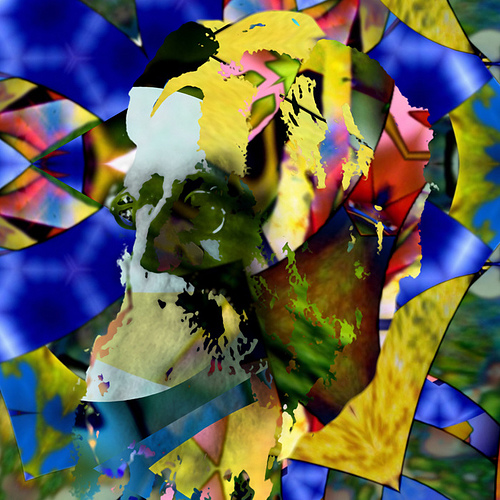
Ein Click auf das Portrait führt zur Population der Evolutionären Portraitkunst erstellt von Dr. Günter Bachelier
Alfred Russel Wallace (* 8. Januar 1823 in Usk, Monmouthshire; † 7. November 1913 in Broadstone, Dorset) war Naturforscher, Philosoph, Sozialist und Aktivist der britischen und irischen Landreformbewegung. Sein offizielles botanisches Autorenkürzel lautet „Wallace“.
Unabhängig von Charles Darwin formulierte er die Evolutionstheorie. Er widersprach eugenischen Ideen und entwarf eine Utopie eines gerechten demokratischen Sozialstaates nach evolutionären Prinzipien.
Wallace war bedeutender Wegbereiter der Biogeographie
und Ökologie. Von 1848 bis 1852 bereiste er das Amazonasgebiet.
Von 1854 bis 1860 forschte er im Malayischen Archipel, von wo aus er
nicht weniger als 125.660 gesammelte und präparierte Exemplare
gesammelter Arten nach England schickte. Die Wallace-Linie
im Malayischen Archipel trägt seinen Namen.
Leben und Reisen
1828 zog die elfköpfige Familie Wallaces nach Hertfort, er war Schüler der Hertford Grammar School. 1836 musste er diese Schule verlassen, er zog 1837 zu seinem Bruder John nach Londoen, der Bauunternehmer war. Die beiden beschäftigten sich intensiv mit den Ideen des Sozialisten Robert Owen. Er nahm noch im selben Jahr die Arbeit im Vermessungsgeschäft seines Bruders William auf und begann eine Uhrmacherlehre. Von 1843 bis 1844 war er Lehrer von „junior classes“ in Leicester. In diesem Jahr trifft er seinen späteren Reisepartner Henry Walter Bates und beginnt Insekten zu sammeln.
Im Jahre 1846 stirbt sein Bruder William, erneut beginnt er eine Zusammenarbeit mit Bruder John, wieder als Landvermesser und er startet ein Architekturprojekt. Von 1848 bis 1858 reiste er nach Südamerika und verlor auf dieser Reise seine gesamte Insektensammlung, weil er auf der Heimreise Schiffbruch erlitt. 1853 veröffentlichte er sein Buch Narrative of Travels on Amazon and Rio Negro. Von 1854 unternahm er bis 1862 wieder eine Reise, diesmal nach Singapur und hielt sich im 'Malayischen Archipel auf, sammelte dort.
Wallace lernt 1864 seine spätere Frau Annie Mitten kennen, wird Assistenzsekretär bei der Royal Geographical Society, 1865 heiratete er sie und bekam mit ihr drei Kinder. Von 1869 bis 1885veröffentlichte er The Malay Archipelago, Land Nationalization,Bad Times und Darwinism, 1879 schrieb er für die Encyclopedia Britannica. Von 1886 bis 1887 hielt er Vorträge in Nordamerika unter anderem in New York, Boston, Washington, San Francisco, Yosemite, Nevada und Quebec. 1897 hielt er weitere Vorlesungen, diesmal in Davos. 1899 veröffentlichte er noch einige Antikriegs-Essays, 1913 The Revolt of Democracy und Social Environment and Moral Progress. Am 7. November sirbt Wallace in Dorset
Der junge Wallace: Autodidakt, Landvermesser und Juniorarchitekt
Alfreds Vater, Thomas Vere Wallace, ein studierter Jurist und bis zur Heirat mit Mary Anne Greenell ein Müßiggänger, publizierte ein aufwändig gestaltetes Literatur- und Kunstmagazin. Aufgrund des geringen kommerziellen Erfolges wechselte die Familie mehrmals den Wohnort, zuletzt nach Usk, Monmouthshire.[1]
In Usk wurde Alfred Russel Wallace am 8. Januar 1823 als achtes von insgesamt neun Kindern (5 Schwestern, 3 Brüder) geboren. 1828 zog die Familie nach Hertford. In den Jahren darauf verlor der Vater einen Großteil des Vermögens als er es einem „Freund“ anvertraute, der es verspekulierte. Alfred besuchte zu dieser Zeit die Hertford Grammar School, wo er Nachhilfe in Lesen, Arithmetik und Schreiben gab. Sein Vater arbeitete inzwischen in der örtlichen Bibliothek und war Mitglied eines Buchclubs. So war die Familie immer mit Büchern versorgt. Alfred las vor allem Reiseerzählungen, aber auch Comics und Lyrik.[2]
Ende 1836, im Alter von 13 Jahren, verließ Wallace die Schule und zog nach London zu seinem Bruder John. Geld verdiente er zeitweise in einem Bauunternehmen. Die Brüder verbrachten ihre Abende oft in der Hall of Science, einer Art Intellektuellenclub, der vor allem von Arbeitern, frühen Sozialisten und Anhängern von Robert Owen besucht wurde. In dieser Zeit las er Age of Reason von Thomas Paine. Im selben Jahr noch zog er zu seinem Bruder William nach Bedfordshire, der ein Landvermessungsbüro betrieb. Alfred arbeitete bis 1843 mit William zusammen (abgesehen von der kurzen Zeit einer Uhrmacherlehre, die er bald abbrach). Im April 1843 starb der Vater.[3]
Weil die Landvermessungsgeschäfte nicht gut liefen, wurde Wallace Lehrer für „junior classes“ in Leicester, wo er 1844 lebte und seinen späteren Reisebegleiter Henry Walter Bates, einen Schmetterlings- und Käfersammler, kennenlernte. Wallace ließ sich begeistern und begann ebenfalls mit dem Sammeln. In der Bibliothek von Leicester las er die Arbeiten von Alexander von Humboldt und Thomas Robert Malthus.[4]
1846 starb sein Bruder William. Zusammen mit John arbeitete er noch einmal kurz als Landvermesser in Neath. Dann folgte ein Architekturprojekt: Der Entwurf des Neath Mechanics Institute & Library.[5]
Der reisende Naturforscher, Biologe und Biogeograph
Vermutlich zwischen 1842 und 1846 las Wallace die Reiseberichte von Humboldt und Charles Darwin. Nach der Lektüre von W.H. Edward's A Voyage up the Amazon beschlossen Wallace und Bates 1847 nach Pará (heute Belém) in Südamerika zu reisen. Zuvor hatten sie sich beim Verantwortlichen der Schmetterlingssammlung des British Museum vergewissert, dass es dort noch viele unentdeckte Arten geben müsse und dass die Reisekosten aus dem Verkauf doppelt gesammelter Exemplare beglichen werden könnten.[6]
Südamerika
1848 querten sie den Atlantik auf der Barke Mischief. Vier Jahre lang sammelten Wallace und Bates am Amazonas und am Rio Negro, bei Barra, Sao Joaquin und Vaupes. Meist gingen sie getrennte Wege. Wallace wurde zeitweise von seinem Bruder Herbert begleitet, bis dieser Ende Mai 1851 an Gelbfieber starb. Auf der Rückreise nach England brach auf dem kautschukbeladenen Schiff Helen Feuer aus. Wallace verlor seine Sammlung. Nur wenige Zeichnungen konnte er ins Beiboot retten. Zehn Tage später nahm sie die Jordeson auf.
Das Material reichte nur für einen kurzen Reisebericht: die Narrative of Travels on Amazon and Rio Negro, wovon 750 Exemplare gedruckt wurden. Immerhin brachte dieser ihm Aufmerksamkeit und Kontakte ein: So lernte Wallace nach seiner Rückkehr in London Thomas Henry Huxley kennen und in der Insektensammlung des Natural History Museum begegnete er Charles Darwin.
Nur aufgrund des Engagements ihres Agenten, der ohne das Wissen der beiden Naturforscher die Sammlung über 200 ₤ versichert hatte, entgingen Wallace und Bates einem finanziellen Desaster. Wallace schätzte später die Verluste auf etwa 500 ₤.[7]
Der Malaiische Archipel
Während der Besuche in den Vogel- und Insektensammlungen des British Museum kam Wallace zu der Überzeugung, dass die Inselgruppen des Malaiischen Archipels, die für eine unglaublich reiche Artenvielfalt berüchtigt waren, wohl das lohnendste Ziel für Sammler und Naturforscher sein müssten.[8]
Mit Hilfe des Präsidenten der Royal Geographical Society, Roderick Murchison, erhielt er ein Ticket nach Singapur Anfang 1854. Acht Jahre verbrachte er im Malaiischen Archipel. Nach Singapur bereiste er Malakka, Borneo, Java, Sumatra, Bali, Lombok, Timor und Celebes, die Molukken und Papua-Neuguinea. Er katalogisierte 125.660 Pflanzen- und Tier-Exemplare und sandte diese nach England.[9] Insbesondere beschäftige er sich auch mit der Verbreitung und Biologie der Paradiesvögel.
Nicht nur die Bedingungen seiner Sammelexkursionen waren beschwerlich, auch die erste Aufarbeitung vor Ort erforderte große Geduld [auf Borneo]:
- ... Meine Sammlungen wurden hier unter mehr als gewöhnlichen Schwierigkeiten präpariert. Ein kleines Zimmer mußte zum Essen, schlafen und Arbeiten, als Vorratshaus und als Sectionszimmer dienen; es waren keine Börter, Schränke, Stühle oder Tische darin; Ameisen krochen überall umher und Hunde, Katzen und Federvieh trat nach Gefallen ein und aus. Daneben stellte es das Sprech- und Empfangszimmer meines Wirthes vor, und ich war genöthigt auf ihn und auf die zahlreichen Gäste, die uns besuchten, Rücksicht zu nehmen. Mein Hauptmöbel war ein Kasten, der mir als Eßtisch, als Stuhl beim Abbalgen und als Aufbewahrungsort für Vögel, wenn sie abgebalgt und getrocknet waren, diente. Um sie vor Ameisen zu schützen, liehen wir uns mit einiger Schwierigkeit eine alte Bank, deren vier Beine in mit Wasser gefüllten Kokosnußschalen gestellt wurden und uns so ziemlich frei von dieser Plage hielten. Der Kasten und die Bank waren jedoch buchstäblich die einzigen Plätze, wohin man etwas legen konnte. ... Man begreift daher wohl leicht, daß wenn irgend etwas von größerem Umfange oder etwas Außergewöhnliches gebracht wurde, die Frage 'Wo kann man es hinlegen?' ziemlich schwierig zu beantworten war. dazu kommt noch , daß alle thierischen Substanzen eine gewisse Zeit brauchen um ganz zu trocknen, daß sie einen sehr unangenehmen Geruch dabei verbreiten und besonders anziehend für Ameisen, Fliegen, Hunde, Ratten, Katzen und anderes Ungeziefer sind, und eine besondere Vorsicht und beständige Aufsicht erfordern, welche unter den oben beschriebenen Umständen unmöglich war. ...[10]
Die Sarawak-Publikation
Nachdem Wallace einige Zeit auf der malayischen Halbinsel verbracht hatte, reiste er nach Sarawak auf Borneo, wo er über ein Jahr forschte und Orang-Utans beobachtete. Hier verfasste er im Februar 1855 auch seine erste bedeutende wissenschaftliche Arbeit, die später als das „Sarawak-Paper“ bekannt werden sollte — der vollständige Titel lautet: On the Law Which Has Regulated the Introduction of New Species.[11]
Inhalt
Aus den allgemein anerkannten geologischen Beobachtungen von Charles Lyell, die dieser im Buch Principles of Geology formuliert hatte, streitet Wallace nun für das Prinzip der langsamen, kontinuierlichen und graduellen Entwicklung der Arten:
- Every species has come into existence coincident both in space and time with a pre-existing closely allied species.
So selbstverständlich dieser Satz heute klingt, so revolutionär war 1855 die Idee einer kontinuierlichen, graduellen Evolution des Lebens: Da alle Arten zusammenhängen und jede Art aus einer nahe verwandten, ähnlichen Art entstanden sein muss, ist auch die Entstehungsgeschichte des Lebens eine Folge von graduellen, kontinuierlichen Entwicklungen. In den Erläuterungen beschrieb er das Klassifizierungssystem der Arten bereits als Baum, dessen Blätter, Äste, Verzweigungen und Stamm die (möglicherweise zum Teil schon ausgestorbenen, nicht mehr existierenden) Arten darstellen, die ihre gemeinsame Wurzel in Antitypen, also Urtypen, haben müssen — eine Interpretation, die allgemein Darwin zugeschrieben wird, der diese Darstellung später in Origin of Species (1859) visualisieren wird.
- Again, if we consider that we have only fragments of this vast system, the stem and main branches being represented by extinct species of which we have no knowledge, while a vast mass of limbs and boughs and minute twigs and scattered leaves is what we have to place in order, and determine the true position each originally occupied with regard to the others, the whole difficulty of the true Natural System of classification becomes apparent to us.
- (Alfred Russel Wallace, On the Law Which Has Regulated the Introduction of New Species, In: Annals and Magazine of Natural History, Volume 16, 1855, p. 187, online [13])
Reaktionen
Der Text wurde im September 1855 in den Annals and Magazine of Natural History gedruckt. Das Echo war gering, jedoch zeigte sich Charles Darwin in einem Brief beeindruckt und merkte an, dass auch ihn dieses Thema beschäftige:
- By your letter, and even still more by your paper in the Annals, a year or more ago, I can plainly see that we have thought much alike and to a certain extent have come to similar conclusions. In regard to the paper in the Annals, I agree to the truth of almost every word of your paper; and I daresay that you will agree with me that it is very rare to find oneself agreeing pretty closely with any theoretical paper; for it is lamentable how each man draws his own different conclusions from the very same fact. This summer will make the twentieth year (!) since I opened my first note-book on the question how and in what way do species and varieties differ from each other. I am now preparing my work for publication, but I find the subject so very large, that though I have written many chapters, I do not suppose I shall go to press for two years. — Letter from C. Darwin to A.R. Wallace, May 1, 1857
- (James Marchant, Alfred Russel Wallace. Letters and Reminiscences, Vol. I, p. 129-130, online [14])
Das Ternate-Essay
Im Januar 1858 erreichte Alfred Russel Wallace, der seit Monaten unter Fieber litt, die Molukken, wo er seinen Essay On the Tendency of Varieties to depart indefinitely from the Original Type formulierte.[12]
Inhalt
Unter Naturforschern des 19. Jahrhunderts war allgemein anerkannt, dass es innerhalb der Arten varieties, Variationen, gibt, die Einfluss auf das Leben der Individuen hatten — schließlich machten genau diese kleinen Unterschiede zwischen den Individuen die Haustierzucht möglich. Auch Wallace war auf seinen Reisen immer wieder geographische Variationen aufgefallen, die gekennzeichnet waren durch kleine Unterschiede in Färbung und Körperbau. Ohne dass diese Eigenschaften der Tiere bedeutend genug waren, um sie als eigene Art zu kennzeichnen. Wallace vermutete nun, dass species, also Arten, nichts anderes als varieties seien, die sich weit genug vom original type, der ursprünglichen Form, entfernt hatten, um als neue, stabile und eigenständige Art zu gelten. Doch wie wurde das Zusammenspiel dieser ständigen graduellen Variationen, sowohl zwischen den Individuen als auch zwischen den Arten geregelt und stabilisiert, so dass der Eindruck einer nahezu konstanten Artenvielfalt entstehen konnte? Und doch so dynamisch und divergent, dass sich aus diesen Variationen immer neue Arten bildeten?
Da sich Populationen in der Natur im geometrischen Verhältnis fortpflanzen (d.h. mit im statistischen Mittel konstanter Zahl von Nachkommen pro Individuum oder Elternpaar), müssten in kürzester Zeit gigantische Populationen entstehen. Wallace beschrieb am Beispiel von Vögeln, die zwei bis zehn Nachkommen pro Jahr zeugen, dass sich ein einzelnes Pärchen innerhalb von nur wenigen Jahren millionenfach vermehren würde. Da uns jedoch die Zahl der existierenden Tiere nahezu konstant erscheint, muss es einen Regelmechanismus geben, der die Natur im Gleichgewicht hält. Im Februar 1858 kam ihm die entscheidende Idee. Inspiriert durch Texte von Thomas Robert Malthus und Robert Chambers beschrieb Wallace das Leben der wilden Tiere und auch das Bestehen ganzer Arten in der Natur als struggle for existence. Evolutionsbiologen sollten dies später als das Prinzip der Selektion bezeichnen.
- The life of wild animals is a struggle for existence. The full exertion of all their faculties and all their energies is required to preserve their own existence and provide for that of their infant offspring. The possibility of procuring food during the least favourable seasons, and of escaping the attacks of their most dangerous enemies, are the primary conditions which determine the existence both of individuals and of entire species.
- (Alfred Russel Wallace, On the Tendency of Varieties to Depart Indefinitely From the Original Type, In: Proceedings of the Linnean Society, Volume 3, 1858, p. 53-62, quoted from p. 54, online [15])
Dieses Prinzip sorge „ganz nebenbei“ für die Anpassung, die Adaption, der Arten an ihre Umwelt. Es regle die Balance zwischen den Individuen einer Art sowie die Verbreitung der Arten:
- Now it is clear that what takes place among the individuals of a species must also occur among the several allied species of a group, — viz. that those which are best adapted to obtain a regular supply of food, and to defend themselves against the attacks of their enemies and the vicissitudes of the seasons, must necessarily obtain and preserve a superiority in population; while those species which from some defect of power or organization are the least capable of counteracting the vicissitudes of food, supply, &c., must diminish in numbers, and, in extreme cases, become altogether extinct. Between these extremes the species will present various degrees of capacity for ensuring the means of preserving life; and it is thus we account for the abundance or rarity of species.
- (Alfred Russel Wallace, On the Tendency of Varieties to Depart Indefinitely From the Original Type, In: Proceedings of the Linnean Society, Volume 3, 1858, p. 53-62, quoted from p. 57, online [16])
Diese Prinzip des Gleichgewichts in der Natur verglich Wallace mit einem Zentrifugalregler einer Dampfmaschine, der Unregelmäßigkeiten ausgleicht kurz bevor sie sichtbar werden: centrifugal governor of the steam engine, which checks and corrects any irregularities almost before they become evident. Das Prinzip geht weit über das hinaus, was Darwin ein Jahr später in seiner Theorie beschreiben sollte — ein vergleichbarer Mechanismus, der die Artenvielfalt kontinuierlich ausbalanciert, fehlt in Darwins Darstellung der Evolutionstheorie. Das Prinzip der divergenten graduellen Variation, der Veränderung von existierenden Arten in winzigen, ungerichteten Schritten weg von ihrem Ursprung, dem original type, wird also durch ein natürliches System von checks and balances geregelt. Es erkläre, so glaubte Wallace, die Entstehung und scheinbare Konstanz der Artenvielfalt, so wie wir sie erleben:
- This progression, by minute steps, in various directions, but always checked and balanced by the necessary conditions, subject to which alone existence can be preserved, may, it is believed, be followed out so as to agree with all the phenomena presented by organized beings, their extinction and succession in past ages, and all the extraordinary modifications of form, instinct, and habits which they exhibit.
- (Alfred Russel Wallace, On the Tendency of Varieties to Depart Indefinitely From the Original Type, In: Proceedings of the Linnean Society, Volume 3, 1858, p. 53-62, quoted from conclusion on p. 62, online [17])
Am 1. März 1858 verfasste Wallace das Begleitschreiben zu seinem Manuskript und sandte den Brief an Charles Darwin mit der Bitte, sein Manuskript, falls er die Ausführungen für sinnvoll hielte, an Charles Lyell weiterzuleiten. Das Postschiff legte am 9. März in Ternate ab mit diesem Brief und einem Schreiben an den Bruder seines alten Reisegefährten Bates.[13]
Reaktionen
Darwin sandte den Aufsatz an Lyell mit der Bemerkung: „I never saw a more striking coincidence; if Wallace had my MS. sketch written out in 1842, he could not have made a better short abstract! Even his terms now stand as heads of my chapters.“[14]
Wenige Tage später schrieb Darwin erneut an Lyell mit der Bitte um Rat: „But as I had not intended to publish any sketch, can I do so honourably, because Wallace has sent me an outline of his doctrine? I would far rather burn my whole book, than that he or any other man should think that I had behaved in a paltry spirit. Do you not think his having sent me this sketch ties my hands?“[15]
So kam es zum „Delicate Arrangement“. Entsprechend dem Rat von Charles Lyell und Joseph Dalton Hooker erstellte Darwin einen Auszug aus seinem Manuskript, das er ab 1839 entworfen hatte, und von dem er Hooker 1844 eine Kopie zu lesen gegeben hatte. Gemeinsam mit der Zusammenfassung eines Briefes an Asa Gray aus dem Jahr 1857, mit dem er zeigen wollte, dass sich seine Ansichten seit 1839 nicht geändert hatten, und mit dem Aufsatz von Wallace wurde dieser Auszug am 1. Juli 1858 in den Sitzungen der Linnean Society of London vorgetragen, und dann im Journal of the Proceedings of the Linnean Society abgedruckt.[16]
1859 erschien Darwins On the Origin of Species. Der Verlag hatte schon am ersten Tag die gesamte Auflage von 1250 Stück an die Buchhändler verkauft. Wallace bekam von Darwin ein Exemplar zugesandt, es erreichte ihn im Jahr 1860. Erst zwei Jahre später kehrte er aus dem Malaiischen Archipel nach London zurück und traf Darwin.[17]
Darwin leitete sein Buch On the Origins of Species, wenn auch erst in späteren Auflagen, mit einem geschichtlichen Überblick ein, in dem er die wichtigsten Quellen angab, aus welchen er Anregungen zu seinen Ideen erhalten hat. Dort findet sich, recht zurückhaltend formuliert, der Hinweis auf Wallace's Essay: „the theory of Natural Selection is promulgated by Mr. Wallace with admirable force and clearness“.[18]
Unklar bleibt wie sehr Darwin von Wallace's Arbeit profitiert hat. Der Historiker John Langdon Brooks etwa versucht zu belegen, dass Darwin einen 41 Seiten langen Einschub zum Divergenzprinzip, geschrieben auf andersfarbigem Papier, erst nach der Lektüre des Ternate-Essays eingefügt hat — und ihm eben dieses letzte Puzzlestück noch in seiner Theorie fehlte. Peter J. Bowler argumentiert im Gegenzug, dass Wallace erst durch seinen Briefwechsel mit Darwin die Prinzipien von Variation und Selektion verstehen konnte — und dass das Ternate-Essay Darwin lediglich zur Veröffentlichung der Ergebnisse seiner Arbeit der letzten 20 Jahre zwang.[19]
Der Darwinist
Alfred Russel Wallace bezeichnete sich zeitlebens als energischsten Verfechter des Darwinismus, gleichzeitig war er einer der einflussreichsten Kritiker unter den ersten Darwinisten. Ihm widerstrebte besonders der Begriff Selection für den Prozess des struggle for existence, da die Metapher der „Selektion“ eine handelnde Autorität impliziere. Er schlug vor, einen Begriff von Herbert Spencer zu übernehmen: survival of the fittest, das dem Überleben des an seine Umwelt Bestangepassten. Darwin verwendete diesen Begriff dann auch ab der 6. Auflage des Origin of Species:
- I wish, therefore, to suggest to you the possibility of entirely avoiding this source of misconception in your great work (if not now too late), and also in any future editions of the "Origin," and I think it may be done without difficulty and very effectually by adopting Spencer's term (which he generally uses in preference to Natural Selection), viz. "Survival of the Fittest." This term is the plain expression of the fact; "Natural Selection" is a metaphorical expression of it, and to a certain degree indirect and incorrect, since, even personifying Nature, she does not so much select special variations as exterminate the most unfavourable ones. — Letter from A.R. Wallace to C. Darwin, July 2, 1866
- (James Marchant, Alfred Russel Wallace. Letters and Reminiscences, Vol. I, p. 171, online [18])
Ein bemerkenswerter Unterschied in den Konzeptionen von Darwin und Wallace liegt in ihrer Herleitung: während Darwin seine Modelle für domesticated animals, also gezüchtete Haustiere entwarf, und dann mit der Analogie zur freien Natur argumentierte, zog Alfred Russel Wallace seine Schlüsse direkt aus den Beobachtungen der Natur. Damit ist er „more Darwinian than Darwin himself“.[20]
Auf seinen Vortragsreisen in Nordamerika und in der Schweiz propagierte er die Ideen der Evolutionstheorie. Darwin und Wallace blieben zeitlebens in Briefkontakt. Bei Charles Darwins Begräbnis am 26. April 1882 war Wallace einer der Sargträger. Wallace erhob nie den Anspruch auf Vorrang an der Evolutionstheorie.[21] Sein 1869 erschienenes Buch The Malay Archipelago beginnt mit der Widmung
- To Charles Darwin, author of "The Origin of Species", I dedicate this book, Not only as a token of personal esteem and friendship. But also To express my deep admiration For His genius and his works.
- (Alfred Russel Wallace, The Malay Archipelago, Macmillan and Co. London, 1869, online [19])
Darwin betonte stets die Hochherzigkeit von Wallace. Die Details der Vorgänge im Jahr 1858 erfuhr Wallace erst aus Darwins Autobiographie. Sieben Jahre nach Darwins Tod, 1891, erschien Wallace' Version des Origin of Species, er nannte sein Buch Darwinism. Ohne Darwins Einfluss wäre der Aufstieg des unbekannten Naturforschers in die elitären wissenschaftlichen Zirkel des viktorianischen Englands wohl kaum möglich gewesen.[22]
Der Landreformer
Die von Wallace in seinem Buch The Malay Archipelago eingestreuten politischen Kommentare machten John Stuart Mill auf ihn aufmerksam, der ihn in die Land Tenure Reform Association einlud. Bis zur Begründung der Land Nationalisation Society 1880 blieb er Mitglied dieser Gesellschaft. Er begann sein in zehn Auflagen gedrucktes Buch Land Nationalisation (1892) mit einem Zitat von James Anthony Froude und machte diese Position zur Grundlage seiner späteren sozialphilosophischen Arbeiten:
- Land is not, and cannot be property in the sense that moveable things are property. Every human being born into this planet must live upon the land if he lives at all. The land in any country is really the property of the nation which occupies it; and the tenure of it by individuals is ordered differently in different places, according to the habits of the people and the general convenience. — FROUDE
- (Alfred Russel Wallace, Land Nationalisation. It's Necessity and it's Aims, Swan Sonnenschein & Co. London - Charles Scribner's Sons New York, 1892, p. vi, online [20])
Über 30 Jahre war Alfred Russel Wallace Präsident der Land Nationalisation Society, als einer der energischsten Fürsprecher für Landreformen in England und Irland.[23]
Der Spiritualist
Ab 1864, etwa zeitgleich mit der Bekanntschaft mit seiner späteren Ehefrau Annie Mitten, änderte sich sein Weltbild: war es zuvor rein materialistisch so wandelte es sich nun zu einem religiös-spirituellen. In einem Brief schrieb er später:
- The completely materialistic mind of my youth and early manhood has been slowly moulded into the socialistic, spiritualistic, and theistic mind I now exhibit — a mind which is, as my scientific friends think, so weak and credulous in its declining years, as to believe that fruit and flowers, domestic animals, glorious birds and insects, wool, cotton, sugar and rubber, metals and gems, were all foreseen and foreordained for the education and enjoyment of man. The whole cumulative argument of my 'World of Life' is that in its every detail it calls for the agency of a mind... enormously above and beyond any human mind. .. Whether this Unknown Reality is a single Being and acts everywhere in the universe as direct creator, organiser, and director of every minutest motion. .. or through 'infinite grades of beings,' as I suggest, comes to much the same thing. Mine seems a more clear and intelligible supposition. .. and it is the teaching of the Bible, of Swedenborg, and of Milton. — Letter from A.R. Wallace to James Marchant, written in 1913.
- (James Marchant, Alfred Russel Wallace. Letters and Reminiscences, Vol. II, p. 181, online [21])
Dass hier der Begründer des Darwinismus eine religiöse, ja geradezu kreationistische Position einnahm, ließ seine Arbeiten im folgenden 20. Jahrhundert manchem Biologen und Biographen suspekt erscheinen. Einige sprechen ihm deshalb sogar jegliches Verständnis von Evolution und geographischer Variation ab. Doch für Wallace stellten Naturwissenschaft und Religion keinen Widerspruch dar.[24]
Er nahm an den zu dieser Zeit sehr populären Séancen teil, und erklärte in seinen Schriften, dass auch und gerade „übernatürliche“, scheinbar unerklärbare Phänomene einer ernsthaften wissenschaftlichen Beschreibung und Untersuchung bedürfen. Seine Kollegen, die sehr viel tiefer als er in der akademischen Gesellschaft des viktorianischen England verwurzelt waren, mochten ihm dabei nicht folgen. Dennoch stellte er seine Ansichten unbeeindruckt in Artikeln und Büchern dar.[25]
Sozialdarwinismus
Das Prinzip der Selektion, des struggle for existence, wurde sowohl von Darwin als auch von Wallace aus den Thesen in Thomas Robert Malthus ökonomischem Essay on the Principle of Population abgeleitet, wenn nicht gar übernommen. Dazu kam bei Darwin wie bei Wallace die Annahme einer kontinuierlichen, graduellen Entwicklung durch ungerichtete Variation. Wer könnte bezweifeln, dass auch dieses Prinzip für menschliche Gesellschaften seine Gültigkeit hat? Dass menschliche Individuen sich unterscheiden, auch wenn sie unzweifelhaft derselben Art angehören?
Nachdem Wallace im Verlauf der 1860er Jahre einige Aufsätze zum Thema der Evolution des Menschen veröffentlicht hatte (beginnend mit The Origin of Human Races and the Antiquity of Man, 1864), erschien 1871 Descent of Man von Charles Darwin. Beide, Darwin und Wallace, glaubten grundsätzlich an die Wirksamkeit evolutionärer Prinzipien in humanen sozialen Systemen: Ideen des Sozialdarwinismus waren in den intellektuellen Kreisen des späten 19. Jahrhunderts weit verbreitet. In Opposition zu Lamarckisten wie Herbert Spencer, Francis Galton und Charles Darwin (sic!) lehnte Wallace jedoch die Erblichkeit von Charakter und Talent strikt ab. Er argumentierte, dass sich Eigenschaften wie etwa Genie sprunghaft, und nicht kontinuierlich durch graduelle Variation entwickelten, und deshalb nicht mit der Evolutionstheorie beschrieben werden könnten. Sie benötigten vielmehr eine eigene Theorie:
- So with men of genius, whose mental faculties have been fully exercised in special directions, whether as men of science, artists, musicians, poets, or statesmen; if not only the inherent faculty but also the increased power derived from its exercise be inherited, then we ought frequently to see these faculties continuously increasing during a series of generations, culminating in some star of the first magnitude. But the very reverse of this is notoriously the case. Men of exceptional genius or mental power or mechanical skill appear suddenly, rising far above their immediate ancestors; and they are usually followed by successors who, though, sometimes great, rarely equal their parent, whose pre-eminent powers seem generation after generation to dwindle away to obscurity.
- (Alfred Russel Wallace, Are Individually Acquired Characters Inherited? (1893), In: Fortnightly Review, p. 490-668, quote from p. 492-493, online [22])
In Opposition zu Galton, Spencer und Darwin, die bedauerten, „that in our modern civilisation natural selection had no play“, dass in der modernen Zivilisation die natürliche Selektion keine Rolle spiele[26] — und den Menschen nahezu als domesticated animal begriffen, als Haustier, das seine Zuchtauswahl selbst in die Hand genommen habe —, wandte sich Wallace energisch gegen eugenische Konzepte. Er wurde, hier in einem Interview als 90-Jähriger, geradezu wütend, wenn seine Theorien als Grundlage für solche Entwürfe zitiert wurden:
- Why, never by word or deed have I given the slightest countenance to eugenics. Segregation of the unfit, indeed! It is a mere excuse for establishing a medical tyranny. And we have enough of this kind of tyranny already. Even now, the lunacy laws give dangerous powers to the medical fraternity. At the present moment, there are some perfectly sane people incarcerated in lunatic asylums simply for believing in spiritualism. The world does not want the eugenist to set it straight. Give the people good conditions, improve their environment, and all will tend towards the highest type. Eugenics is simply the meddlesome interference of an arrogant, scientific priestcraft.
- (The Last of the Great Victorians. Special Interview with Dr. Alfred Russel Wallace, In: The Millgate Monthly, August 1912, p 657-663, quote p. 663, online [23])
Auch Wallace's sozialistische Gesellschaftsutopie enthielt das Prinzip der Selektion, jedoch nicht durch eine „scientific priestcraft“, eine elitäre „wissenschaftliche Priesterschaft“, sondern durch die freie Wahl der Ehemänner durch ihre Frauen, frei von wirtschaftlichen Zwängen.[27] Kurz vor seinem Tod beschrieb er diese Vision in seinem Buch Social Environment and Moral Progress (1913)[24]. Geradezu prophetisch schienen seine Warnungen vor jeder Art von elitären eugenischen Systemen:
- But there is great danger in such a process of artificial selection by experts, who would certainly soon adopt methods very different from those of the founder. We have already had proposals made for the "segregation of the feeble-minded," while the "sterilization of the unfit" and of some classes of criminals is already being discussed. This might soon be extended to the destruction of deformed infants, as was actually proposed by the late Grant Allen; while Mr. Hiram M. Stanley, in a work on Our Civilization and the Marriage Problem, proposed more far-reaching measures. He says: "The drunkard, the criminal, the diseased, the morally weak, should never come into society. Not reform, but prevention, should be the cry."
- Of course, our modern eugenists will disclaim any wish to adopt such measures as are here hinted at, which are in every way dangerous and detestable. But I protest strenuously against any direct interference with the freedom of marriage, which, as I shall show, is not only totally unnecessary, but would be a much greater source of danger to morals and to the well-being of humanity than the mere temporary evils it seeks to cure. I trust that all my readers will oppose any legislation on this subject by a chance body of elected persons who are totally unfitted to deal with far less complex problems than this one, and as to which they are sure to bungle disastrously.
- (Alfred Russel Wallace, Social Environment and Moral Progress, 1913, p. 142-144, online [25])
Er wünschte sich eine Gesellschaft, in der Land und materielles Vermögen nicht vererbt werden kann, in dem jeder die gleichen Chancen und Startbedingungen hat, am struggle towards freedom teilzunehmen.[28]
Der Sozialphilosoph und Sozialist
Schon früh setzte sich Wallace mit dem frühen englischen Sozialisten und Sozialreformer Robert Owen auseinander, dessen Vorträge er erstmals 1837 in London hörte.[29] Gegenüber seinem Freund James Marchant stellte er seinen politischen Standpunkt später wie folgt dar:
- "Why am I a Socialist?" "I am a Socialist because I believe that the highest law for mankind is justice. I therefore take for my mottoe, 'Fiat Justitia, Ruat Cœlum'; and my definition of Socialism is, 'The use, by everyone, of his faculties for the common good, and the voluntary organisation of labour for the equal benefit of all.' That is absolute social justice; that is ideal Socialism. It is, therefore, the guiding star for all true social reform."
- (James Marchant, Alfred Russel Wallace. Letters and Reminiscences, Harper and Brothers Publishers, New York and London 1916, Vol. II, p. 152-153, online [26])
Im Fazit seines Essay True Individualism — The Essential Preliminary of a Real Social Advance schreibt er über seinen Traum eines gerechten Gesellschaftssystems, das jedem Mitglied das gleiche Recht auf einen guten Start ins Leben und eine bestmögliche Bildung zugesteht — eine Gesellschaft, die ohne ein Wettrennen um Wohlstand und Luxus auskommt:
- Under such a system of society as is here suggested, when all were well educated and well trained and were all given an equal start in life, and when every one knew that however great an amount of wealth he might accumulate he would not be allowed to give or bequeath it to others in order that they might be free to live lives of idleness or pleasure, the mad race for wealth and luxury would be greatly diminished in intensity, and most men would be content with such a competence as would secure to them an enjoyable old age. And as work of every kind would have to be done by men who were as well educated and as refined as their employers, while only a small minority could possibly become employers, the greatest incentive would exist towards the voluntary association of workers for their common good, thus leading by a gradual transition to various forms of co-operation adapted to the conditions of each case. With such equality of education and endowment none would consent to engage in unhealthy occupations which were not absolutely necessary for the well-being of the community, and when such work was necessary they would see that every possible precautions were taken against injury. All the most difficult labour-problems of our day would thus receive an easy solution.
- (Alfred Russel Wallace, True Individualism — The Essential Preliminary of a Real Social Advance, In: Studies scientific & social, Macmillan & Co. London 1900, Vol II, p. 510, online [27])
Neben seinen Aufsätzen beschreiben wohl die im letzten Lebensjahr, 1913, entstandenen Werke The Revolt of Democracy [28] und Social Environment and Moral Progress [29] seinen Standpunkt am deutlichsten.
Kampagnen wider die Impfprogramme
Wallace engagierte sich gegen das Impfprogramm, die Impfpflicht zur Eindämmung der Pocken. In Aufsätzen und im 1889 erschienenen Buch Vaccination a Delusion versuchte er, statistisch nachzuweisen, dass Impfprogramme nach anfänglichen Erfolgen in den ersten Jahrzehnten im ausgehenden 19. Jahrhundert der öffentlichen Gesundheit eher schadeten als nutzten. Wallace glaubte nicht an die Möglichkeit einer weltweiten Ausrottung des Pockenvirus. Erst 1980, 91 Jahre später, konnte die WHO den Sieg über das Pockenvirus melden. Seitdem gilt es als ausgestorben.[30]
Nachleben
Alfred Russel Wallace hat sich gerade mit seinen politischen und religiösen Schriften angreifbar gemacht. So wie er in frühen Veröffentlichungen prägnant und mit analytischer Schärfe seine Beobachtungen interpretierte, so leidenschaftlich propagierte er auch seine religiösen und politischen Ansichten. Er polarisierte Zeitgenossen und Biographen.
Im wissenschaftlichen Diskurs hat sich im späten 19. und 20. Jahrhundert zumeist Darwins Modell der biologischen und sozialen Evolution durchgesetzt, die Wallace-spezifischen Aspekte der dynamischen Balance zwischen den Arten, der Diversifikation der Arten gerieten lange in den Hintergrund.
Ehrungen
Alfred Russel Wallace wurde nie Mitglied der etablierten intellektuellen Elite des viktorianischen England; zu unorthodox und unangepasst waren seine Ansichten. Nichtsdestoweniger erhielt er schon zu Lebenszeiten viele Auszeichnungen und Titel, unter anderem:
- 1868 die Royal Medal der Royal Society
- 1882 Ehrendoktor der Universität Dublin
- 1889 Ehrendoktor der Universität Oxford
- 1892 die Founders Medal der Royal Geographical Society
- 1892 die Linné-Medaille der Linnean Society of London
- 1893 Mitglied der Royal Society
- 1908 Verdienstorden der Krone
- 1908 die Copley-Medaille der Royal Society
Auf Mond und Mars sind Krater nach ihm benannt. Die Trennlinie zwischen den biogeographischen Gebieten Australiens und Südostasiens trägt ihm zu Ehren den Namen Wallace-Linie. Darüber hinaus sind zahlreiche Organismen nach ihm benannt, wie der Wallace-Paradiesvogel (Semioptera wallacii) und die Gattung Wallacea Spruce der Pflanzenfamilie der Ochnaceae.
Bibliographie
Alfred Russel Wallace veröffentlichte Artikel, Essays und Bücher. Der Übersichtlichkeit halber werden hier nur die Bücher aufgelistet. Viele seiner Texte sind beim Gutenberg Projekt und auf der Alfred-Russel-Wallace-Webseite verfügbar [30].
Werke
- 1853 Palm Trees on the Amazon
- 1853 A Narrative of Travels on the Amazon and Rio Negro
- 1857 On the Natural History of the Aru Islands. In: The Annals and Magazine of Natural History, Dez. 1857, Schlüsselwerk der Inselbiogeographie.[31]
- 1866 The Scientific Aspect of the Supernatural
- 1869 The Malay Archipelago
- 1870 Contributions to the Theory of Natural Selection
- 1874 Miracles and Modern Spiritualism
- 1876 The Geographical Distribution of Animals
- 1878 Tropical Nature and other Essays
- 1879 Australasia. Stanford's Compendium of Geography and Travel
- 1880 Island Life
- 1882 Land Nationalisation
- 1885 Bad Times
- 1889 Darwinism
- 1898 The Wonderful Century
- 1900 Studies, Scientific and Social
- 1901 The Wonderful Century Reader
- 1901 Vaccination a Delusion
- 1903 Man's Place in the Universe
- 1905 My Life
- 1907 Is Mars Habitable?
- 1910 The World of Life
- 1913 Social Environment and Moral Progress
- 1913 The Revolt of Democracy
Eine Liste aller veröffentlichten Artikel und Aufsätze findet sich bei James Marchant: Alfred Russel Wallace. Letters and Reminiscences, Vol. II, ab Seite 258, online [32].
Sekundärliteratur und Biographien
- Barbara G. Beddall: Wallace, Darwin and the Theory of Natural Selection. A Study in the Development of Ideas and Attitudes, in: Journal of the History of Biology, 1 (1968), p. 261-323.
- Andrew Berry: Infinite Tropics. An Alfred Russel Wallace Anthology, Verso London and New York, 2002, ISBN 1-85984-652-1
- Peter J. Bowler: Alfred Russel Wallace's Concepts of Variation, in: Journal of the History of Medicine and Allied Sciences, Vol. 31, 1976, p.17-29.
- Arnold C. Brackman: A delicate Arrangement. The strange Case of Charles Darwin and Alfred Russel Wallace, Times Books New York, 1980, ISBN 0-8129-0883-X
- John Langdon Brooks: Just Before the Origin: Alfred Russel Wallace's Theory of Evolution, iUniverse, 1999, ISBN 1-58348-111-7
- Petra Höfer & Freddie Röckenhaus: Tropenfieber - Im Land der Kopfjäger, Film über Wallace in der Serie der ZDF Expedition, Erstausstrahlung am 21. September 2003.
- James Marchant: Alfred Russel Wallace. Letters and Reminiscences, Harper and Brothers Publishers New York and London, 1916, online Vol. I [33], Vol. II [34], reprint ISBN 1-4219-5535-0
- H. Lewis McKinney: Wallace and Natural Selection, Yale University Press New Haven and London, 1972, ISBN 0-300-01556-9
- David Quammen: Der Gesang des Dodo, Claassen Verlag, 1998, ISBN 3-548-60040-9
- Peter Raby: Alfred Russel Wallace. A Life, Chatto & Windus London, 2001, ISBN 0-7011-6838-2
- Tim Severin: The Spice Islands Voyage: The Quest for Alfred Wallace, the Man Who Shared Darwin's Discovery of Evolution, Ulverscroft Large Print, 1998, ISBN 0-7867-0721-6
- Amabel Williams-Ellis: Darwin's moon. A Biography of Alfred Russel Wallace, Blackie London and Glasgow, 1966, ISBN 0-216-88398-9
Siehe auch
Weblinks
- Literatur von und über Alfred Russel Wallace im Katalog der Deutschen Nationalbibliothek
- Autoreintrag und Liste der beschriebenen Pflanzennamen für Alfred Russel Wallace bei IPNI.
- Die Alfred Russel Wallace Page – Biographie, Bibliographie und viele Originaltexte online.
- http://home.tiscalinet.ch/biografien/biografien/wallace.htm – Biographie und weitere Informationen.
- Darwin Correspondence Project – Darwins Briefe, auch die Korrespondenz mit Wallace, online verfügbar.
Anmerkungen und Quellennachweis
- ↑ Vgl. Alfred Russel Wallace, My Life (1), p. 7, 10-12.
- ↑ Vgl. Alfred Russel Wallace, My Life (1), p. 12-13, 17, 46, 58, 74-76.
- ↑ Vgl. Alfred Russel Wallace, My Life (1), p. 79, 87, 106, 135-139, 223.
- ↑ Vgl. Alfred Russel Wallace, My Life (1), p. 223, 230, 232, 237.
- ↑ Vgl. Alfred Russel Wallace, My Life (1), p. 239-245, 241, 264.
- ↑ Vgl. Alfred Russel Wallace, My Life (1), p. 232, 264.
- ↑ Vgl. Alfred Russel Wallace, My Life (1), p. 267, 275-281, 304-312, 320-321, 323-324.
- ↑ Vgl. Alfred Russel Wallace, My Life (1), p. 326-327.
- ↑ Vgl. Alfred Russel Wallace, My Life (1), p. 326-336. Sein Reisebericht ist gespickt mit Naturbeobachtungen und Analysen der kolonialen Gesellschaftsverhältnisse. Im Vorwort (The Malay Archipelago (1), p. xiv) schlüsselt er die gesammelten Arten auf.
- ↑ Vgl. Alfred Russel Wallace, Der Malayische Archipel, Bd. 1, S. 225.
- ↑ Vgl. Alfred Russel Wallace, My Life (1), p. 54-355, 341.
- ↑ Vgl. Alfred Russel Wallace, The Malay Archipelago, p. 359.
- ↑ Die Chronologie der Ereignisse dieser Tage ist von Historikern im Streit um die Priorität Wallace gegen Darwin verschiedentlich rekonstruiert worden, u.a. von Brooks: Just Before the Origin.
- ↑ Vgl. Letter CHARLES DARWIN TO C. LYELL. Down, 18th (June 1858), reprinted in Francis Darwin, The Life and Letters of Charles Darwin, online [1].
- ↑ Vgl. Letter CHARLES DARWIN TO C. LYELL. Down, Friday (June 25, 1858), reprinted in Francis Darwin, The Life and Letters of Charles Darwin, online [2].
- ↑ Vgl. Journal of the Proceedings of the Linnean Society, Vol. III, London 1859, p.45-62. Mit dem einleitenden Vortrag von Lyell und Hooker online verfügbar auf der Website der Linnean Society und beim British Library [3].
- ↑ Vgl. Alfred Russel Wallace, My Life (2), p. 1.
- ↑ Vgl. Charles Darwin: The Origin of Species by means of Natural Selection, 6th edition, London 1872, p. xxi (online [4]).
- ↑ Vgl. Peter J. Bowler, Alfred Russel Wallace's Concepts of Variation, und John Langdon Brooks, Just Before the Origin: Alfred Russel Wallace's Theory of Evolution.
- ↑ Vgl. Alfred Russel Wallace, My Life (2), p. 1-22, auch James Marchant, Alfred Russel Wallace. Letters and Reminiscences, Vol. II, p.15, online [5].
- ↑ Vgl. Alfred Russel Wallace, My Life (2), p. 102, 107ff.
- ↑ So zumindest die Meinung einiger seiner Biographen: XXX TODO!!! Namen!!! XXX.
- ↑ Vgl. Alfred Russel Wallace, My Life (2), p. 235, 240.
- ↑ Es schien im 20. Jahrhundert zur Pflicht eines Naturwissenschaftlers zu gehören, die Unvereinbarkeit der Wissenschaft mit konfessionellen oder gar spiritualistischen Glaubensbekenntnissen zu postulieren. In den Jahrhunderten zuvor wurde das nicht so eng gesehen: Malthus war anglikanischer Pfarrer, Darwin und Newton studierte Theologen (letzterer etwa veröffentlichte mehr theologische als naturwissenschaftliche Schriften). Ihr Deismus beschrieb Gott als Schöpfer der Naturgesetze, der das Regelwerk schuf, das es als Naturforscher zu erkennen galt – Wallace'sche Standpunkt war in etwa analog.
- ↑ Vgl. z.B. James Marchant, Alfred Russel Wallace. Letters and Reminiscences, Vol II, p. 187, Letter T.H. Huxley to A.R. Wallace (online [6]). Der erste Aufsatz zum Thema, „The Scientific Aspect of the Supernatural: Indicating the Desirableness of an Experimental Enquiry by Men of Science into the Alleged Powers of Clairvoyants and Mediums“, erschien 1866 (online [7]). Zu Wallace's spiritualistischen Ansichten wurde viel geschrieben, ein guter Einstieg in den Diskurs ist vielleicht Charles H. Smith: „Alfred Russel Wallace on Spiritualism, Man, and Evolution: An Analytical Essay“ (online [8]).
- ↑ Vgl. z.B. Wallace's Einführung in Human Selection (1890), p. 325, online [9].
- ↑ Vgl. Alfred Russel Wallace, Social Environment and Moral Progress, p. 147, online [10].
- ↑ Wallace definiert in seinen Ausführungen Progress, also Fortschritt, in Richtung des Zieles einer moralischen, gerechten und gleichberechtigten Gesellschaft. Die Phrase struggle towards freedom ist hier etwas kontextlos zitiert. Dies sei in diesem Fall ausnahmsweise erlaubt, da Wallace die Entwicklung der Zivilisationen als solchen begriff (vgl. dazu Alfred Russel Wallace, Social Environment and Moral Progress, p.134-135, online [11]). Die Darstellung seiner Ideen über gerechte Besitzverhältnissen finden sich in Social Environment and Moral Progress und Texten zur Landreform.
- ↑ Vgl. Alfred Russel Wallace, My Life (1), p. 87.
- ↑ Wallace sieht den Zwang zur Impfung als Eingriff in die Persönlichkeitsrechte an. Er argumentiert nicht, wie etwa Haeckel (Die Lebenswunder, 1905) oder Darwin (Descent of Man, 1871, p. 134 in 2nd. ed., London 1882, online [12]), dass durch Impfungen der Prozess der natürlichen Selektion ausgehebelt, und damit die Evolution der Menschheit gefährdet sei. Wallace zweifelt die zuverlässige Immunisierung durch Vaccination an; er beschreibt Fälle aus Navy und Army, bei denen es trotz Immunisierung zu Pockenansteckungen kam. Vgl. etwa Alfred Russel Wallace: Vaccination a Delusion, London 1898 (online http://www._dot_whale_dot_.to/vaccine/wallace/book.html (_dot_ entfernen!), chapter 4: The Army and Navy as a Conclusive Test). Die entsprechenden Aufsätze werden bis heute von Gegnern der Impfpflicht zitiert.
Quelle (05.2008): http://de.wikipedia.org/wiki/Alfred_Russel_Wallace
Alfred Russel Wallace OM, FRS (8 January 1823 – 7 November 1913) was a Welsh[1] naturalist, explorer, geographer, anthropologist and biologist.
He did extensive fieldwork first in the Amazon River basin, and then in the Malay Archipelago, where he identified the Wallace line dividing the fauna of Australia from that of Asia. He is best known for independently proposing a theory of natural selection which prompted Charles Darwin to publish on his own theory. Wallace was also one of the leading evolutionary thinkers of the 19th century who made a number of other contributions to the development of evolutionary theory, including the concept of warning colouration in animals, and the Wallace effect. He was also considered the 19th century’s leading expert on the geographical distribution of animal species and is sometimes called the "father of biogeography".[2]
Wallace was strongly attracted to unconventional ideas. His advocacy
of Spiritualism
and his belief in a non-material origin
for the higher mental faculties of humans strained his relationship
with the scientific establishment, especially with other early
proponents of evolution. He was critical of what he considered to be an
unjust social and economic system in 19th century Britain, and was one
of the first prominent scientists to raise concerns over the
environmental impact of human activity.
Biography
Early life
Wallace was born in the village of Llanbadoc, near Usk, Monmouthshire, Wales.[3] He was the eighth of nine children of Thomas Vere Wallace and Mary Anne Greenell. His mother was from a respectable middle-class English family from Hertford. Thomas Wallace was of Scottish ancestry and his family, like many Scottish Wallaces, claimed a connection to William Wallace, the leader of a 13th-century rising against England. Thomas Wallace received a law degree but never actually practiced law. He inherited some income-generating property, but bad investments and failed business ventures resulted in a steady deterioration of the family's financial position.[4]
When Wallace was five years old, his family moved to Hertford, north of London, where he attended Hertford Grammar School until financial difficulties forced his family to withdraw him in 1836.[5] Wallace then moved to London to live and work with his older brother John, a 19-year-old apprentice builder. At one point during this time, he lived at 44 St. Peter's Road in Croydon, the plaque was put there in 1979. This was a stopgap measure until William, his oldest brother, was ready to take him on as an apprentice surveyor. While there he attended lectures and read books at the London Mechanics' Institute, where he was exposed to the radical political ideas of social reformers like Robert Owen and Thomas Paine. He left London in 1837 to live with William and work as his apprentice for six years. At the end of 1839 they moved to Kington near the Welsh border before eventually settling at Neath in Glamorgan, and between 1840 and 1843, Wallace did surveying work in the countryside of the west of England and Wales.[6][7] By the end of 1843 William's business had declined due to difficult economic conditions, and Wallace left in January.
After a brief period of unemployment, he was hired as a master at the Collegiate School in Leicester to teach drawing, map making, and surveying. Wallace spent a lot of time at the Leicester library where he read An Essay on the Principle of Population by Thomas Malthus and where one evening he met the entomologist Henry Bates. Bates was only 19 years old but had already published a paper on beetles in the journal Zoologist. He befriended Wallace and started him collecting insects.[8][9] William died in March 1845, and Wallace left his teaching position to assume control of his brother's firm in Neath. He and his brother John were unable to make the business work, and after a couple of months Wallace found work as a civil engineer for a nearby firm that was working on a survey for a proposed railway in the Vale of Neath. Wallace's work on the survey involved spending a lot of time outdoors in the countryside, allowing him to indulge his new passion for collecting insects. Wallace was able to persuade his brother John to join him in starting another architecture and civil engineering firm, which carried out a number of projects including designing a building for the Mechanics' Institute of Neath. William Jevons, the founder of that institute, was impressed by Wallace and persuaded him to give lectures there on science and engineering. In the autumn of 1846 he and John were able to purchase a cottage near Neath, where they lived with their mother and sister Fanny (his father had died in 1843).[10][11] During this period he read avidly, exchanging letters with Bates about the anonymous evolutionary treatise Vestiges of the Natural History of Creation, Charles Darwin's Journal and Remarks, and Charles Lyell's Principles of Geology.[12]
Exploration and study of the natural world
Inspired by the chronicles of earlier traveling naturalists including Alexander von Humboldt, Charles Darwin, and William Henry Edwards, Wallace decided that he too wanted to travel abroad as a naturalist.[13] In 1848 Wallace and Henry Bates left for Brazil aboard the Mischief. Their intention was to collect insects and other animal specimens in the Amazon Rainforest and sell them to collectors back in England. They also hoped to gather evidence of the transmutation of species. Wallace and Bates spent most of their first year collecting near Belém do Pará, then explored inland separately, occasionally meeting to discuss their findings. In 1849, they were briefly joined by another young explorer, botanist Richard Spruce, along with Wallace's younger brother Herbert; Herbert left soon after (dying two years later from yellow fever), but Spruce, like Bates, would spend over ten years collecting in South America.[14]
Wallace continued charting the Rio Negro for four years, collecting specimens and making notes on the peoples and languages he encountered as well as the geography, flora, and fauna.[15] On 12 July 1852, Wallace embarked for England on the brig Helen. After twenty-eight days at sea, balsam in the ship's cargo caught fire and the crew was forced to abandon ship. Wallace's entire collection was lost, and he could only save part of his diary and a few sketches. Wallace and the crew spent ten days in an open boat before being picked up by the brig Jordeson.[16]
After his return to England, Wallace spent eighteen months in London living on the insurance payment for his lost collection and selling the surviving remnants. During this period, despite having lost almost all of the notes from his South American expedition, he wrote six academic papers (which included "On the Monkeys of the Amazon") and two books; Palm Trees of the Amazon and Their Uses and Travels on the Amazon.[17] He also made connections with a number of other British naturalists—most significantly, Darwin.[18][19]
From 1854 to 1862, Wallace travelled through the Malay Archipelago or East Indies (now Malaysia and Indonesia), to collect specimens for sale and to study nature. His observations of the marked zoological differences across a narrow strait in the archipelago led to his proposing the zoogeographical boundary now known as the Wallace line. Wallace collected more than 125,000 specimens in the Malay Archipelago (more than 80,000 beetles alone), and more than a thousand of them represented species new to science.[20] One of his better known species descriptions during this trip is the gliding tree frog Rhacophorus nigropalmatus, known as Wallace's flying frog. While he was exploring the archipelago he refined his thoughts about evolution and had his famous insight on natural selection.
His studies and adventures there were eventually published in 1869 as The Malay Archipelago. The Malay Archipelago became one of the most popular journals of scientific exploration of the 19th century, kept continuously in print by its original publisher (Macmillan) into the 2nd decade of the 20th century. It was praised by scientists such as Darwin (to whom the book was dedicated), and Charles Lyell, and by non scientists such as the novelist Joseph Conrad who called it his "favorite bedside companion", and used it as source of information for several of his novels, especially Lord Jim.[21]
Return to England, marriage and children
In 1862 Wallace returned to England, where he moved in with his sister Fanny Sims and her husband Thomas. While recovering from his travels, Wallace organized his collections and gave numerous lectures about his adventures and discoveries to scientific societies such as the Zoological Society of London. Later that year he visited Darwin at home, and became friendly with both Charles Lyell and Herbert Spencer.[22] During the 1860s Wallace wrote papers and gave lectures defending natural selection, and corresponded with Darwin about a variety of topics including sexual selection, warning colouration, and the possible effect of natural selection on hybridization and the divergence of species.[23] In 1865 he began investigating spiritualism.[24]
After a year of courtship, Wallace became engaged in 1864 to a young woman whom in his autobiography he would only identify as Miss L. However, to Wallace's great dismay, she broke off the engagement.[25] In 1866 Wallace married Annie Mitten. Wallace had been introduced to Mitten through Richard Spruce, who had befriended Wallace in Brazil, and who was also a good friend of Annie Mitten's father, William Mitten, an expert in mosses. In 1872, Wallace had a house built of concrete on land he leased in Grays in Essex where he lived until 1876. The Wallaces had three children; Herbert (1867–1874) who died in childhood, Violet (1869–1945), and William (1871–1951).[26]
Financial struggles
In the late 1860s and 1870s Wallace was very concerned about the financial security of his family. While he was in the Malay Archipelago the sale of specimens had brought in a considerable amount of money, which had been carefully invested by the agent who sold the specimens for Wallace. However, on his return to England Wallace made a series of bad investments in railways and mines that squandered most of the money, and he found himself badly in need of the proceeds from the publication of The Malay Archipelago.[27] Despite assistance from his friends he was never able to secure a permanent salaried position such as curatorship of a museum. In order to remain financially solvent Wallace worked grading government examinations, wrote 25 papers for publication between 1872 and 1876 for various modest sums, and was paid by Lyell and Darwin to help edit some of their own works.[28] In 1876 Wallace needed a £500 advance from the publisher of The Geographical Distribution of Animals to avoid having to sell some of his personal property.[29] Darwin was very aware of Wallace's financial difficulties and lobbied long and hard to get Wallace awarded a government pension for his lifetime contributions to science. When the £200 annual pension was awarded in 1881 it helped to stabilize Wallace's financial position by supplementing the income from his writings.[30]
Social activism
John Stuart Mill was impressed by remarks criticizing English society that Wallace had included in The Malay Archipelago, and asked him to join the general committee of his Land Tenure Reform Association, but the association dissolved after Mill's death in 1873 and Wallace wrote only a handful of articles on political and social issues before 1879. However, in that year he entered the debates over trade policy and land reform in earnest. He believed that rural land should be owned by the state and leased to people who would make whatever use of it that would benefit the largest number of people, thus breaking the often-abused power of wealthy landowners in English society. In 1881 Wallace was elected as the first president of the newly formed Land Nationalisation Society. The next year he published a book, Land Nationalisation; Its Necessity and Its Aims, on the subject. He criticized England's free trade policies for the negative impact they had on working class people.[31][19] In 1889 Wallace read Looking Backward by Edward Bellamy and declared himself a socialist.[32] These ideas led him to oppose both Social Darwinism and Eugenics, ideas supported by other prominent 19th century evolutionary thinkers, on the grounds that contemporary society was too corrupt and unjust to allow any reasonable determination of who was fit or unfit.[33] In 1898 Wallace wrote a paper advocating a pure paper money system, unbacked by silver or gold, which impressed the economist Irving Fisher so much that he dedicated his 1920 book Stabilizing the Dollar to Wallace.[34] Wallace wrote extensively on other social topics including his support for woman's suffrage, and the dangers and wastefulness of militarism.[35][36] Wallace continued his social activism for the rest of his life, publishing the book The Revolt of Democracy just weeks before his death.[37]
Wallace continued his scientific work in parallel with his social commentary. In 1880 he published Island Life as a sequel to The Geographic Distribution of Animals. In November 1886 Wallace began a ten month trip to the United States to give a series of popular lectures. Most of the lectures were on Darwinism (evolution and natural selection), but he also gave speeches on biogeography, spiritualism, and social/economic reform. During the trip he was reunited with his brother John who had emigrated to California years before. He also spent a week in Colorado, with the American botanist Alice Eastwood as his guide, exploring the flora of the Rocky Mountains and gathering evidence that would lead him to a theory on how glaciation might explain certain commonalities between the mountain flora of Europe, Asia and North America, which he published in 1891 in the paper "English and American Flowers". He met many other prominent American naturalists and viewed their collections. His 1889 book Darwinism used information he collected on his American trip, and information he had compiled for the lectures.[38][39]
Death
On 7 November 1913, Wallace died at home in the country house he called Old Orchard, which he had built a decade earlier.[40] He was 90 years old. His death was widely reported in the press. The New York Times called him "the last of the giants belonging to that wonderful group of intellectuals that included, among others, Darwin, Huxley, Spencer, Lyell, and Owen, whose daring investigations revolutionized and evolutionized the thought of the century." Another commentator in the same edition said “No apology need be made for the few literary or scientific follies of the author of that great book on the 'Malay Archipelago'.”[41] Some of Wallace's friends suggested that he be buried in Westminster Abbey, but his wife followed his wishes and had him buried in the small cemetery at Broadstone, Dorset.[40] Several prominent British scientists formed a committee to have a medallion of Wallace placed in Westminster near where Darwin had been buried. The medallion was unveiled on November 1, 1915.
Theory of evolution
Early evolutionary thinking
Unlike Darwin, Wallace began his career as a travelling naturalist already believing in the transmutation of species. The concept had been advocated by Jean-Baptiste Lamarck, Geoffroy Saint-Hilaire, Erasmus Darwin, and Robert Grant, among others. It was widely discussed, but not generally accepted by leading naturalists, and was considered to have radical, even revolutionary connotations.[42][43] Prominent anatomists and geologists such as Georges Cuvier, Richard Owen, Adam Sedgwick, and Charles Lyell attacked it vigorously.[44][45] It has been suggested that Wallace accepted the idea of the transmutation of species in part because he was always inclined to favour radical ideas in politics, religion and science[42], and because he was unusually open to marginal, even fringe ideas in science.[46]
He was also profoundly influenced by Robert Chambers' work Vestiges of the Natural History of Creation, a highly controversial work of popular science published anonymously in 1844 that advocated an evolutionary origin for the solar system, the earth, and living things.[47] Wallace wrote to Henry Bates in 1845:
I have a rather more favourable opinion of the ‘Vestiges’ than you appear to have. I do not consider it a hasty generalization, but rather as an ingenious hypothesis strongly supported by some striking facts and analogies, but which remains to be proven by more facts and the additional light which more research may throw upon the problem. It furnishes a subject for every student of nature to attend to; every fact he observes will make either for or against it, and it thus serves both as an incitement to the collection of facts, and an object to which they can be applied when collected.[48]
Wallace deliberately planned some of his field work to test the hypothesis that under an evolutionary scenario closely related species should inhabit neighbouring territories.[42] During his work in the Amazon basin he came to realize that geographical barriers—such as the Amazon and its major tributaries—often separated the ranges of closely allied species, and he included these observations in his 1853 paper "On the Monkeys of the Amazon".[49] Near the end of the paper he asks the question "Are very closely allied species ever separated by a wide interval of country?"
In February 1855, while working in the state of Sarawak on the island of Borneo, Wallace wrote "On the Law Which has Regulated the Introduction of Species", a paper which was published in the Annals and Magazine of Natural History in September 1855. In this paper he gathered and enumerated general observations regarding the geographic and geologic distribution of species (biogeography). His conclusion that "Every species has come into existence coincident both in space and time with a closely allied species" has come to be known as the "Sarawak Law". Wallace thus answered the question he had posed in his earlier paper on the monkeys of the Amazon river basin. Although it contained no mention of any possible mechanisms for evolution, this paper foreshadowed the momentous paper he would write three years later.[50]
The paper shook Charles Lyell's belief that species were immutable. Although his friend Charles Darwin had written to him in 1842 expressing support for transmutation, Lyell had continued to be strongly opposed to the idea. Around the start of 1856 he told Darwin about Wallace's paper, as did Edward Blyth who thought it "Good! Upon the whole!… Wallace has, I think put the matter well; and according to his theory the various domestic races of animals have been fairly developed into species." Despite this hint, Darwin mistook Wallace's conclusion for the progressive creationism of the time and wrote that it was "nothing very new… Uses my simile of tree [but] it seems all creation with him." Lyell was more impressed, and opened a notebook on species where he grappled with the consequences, particularly for human ancestry. Darwin had already shown his theory to their mutual friend Joseph Hooker, and now for the first time he spelt out the full details of natural selection to Lyell. Although Lyell could not agree, he urged Darwin to publish to establish priority. Darwin demurred at first, then began writing up a species sketch of his continuing work in May 1856.[51]
Natural selection and Darwin
- See also: Publication of Darwin's theory
By February 1858 Wallace had been convinced by his biogeographical research in the Malay Archipelago of the reality of evolution. As he later wrote in his autobiography:
The problem then was not only how and why do species change, but how and why do they change into new and well defined species, distinguished from each other in so many ways; why and how they become so exactly adapted to distinct modes of life; and why do all the intermediate grades die out (as geology shows they have died out) and leave only clearly defined and well marked species, genera, and higher groups of animals?[52]
According to his autobiography, it was while he was in bed with a fever that Wallace thought about Thomas Malthus's idea of positive checks on human population growth, and came up with the idea of natural selection.[53] Wallace said in his autobiography that he was on the island of Ternate at the time, but historians have questioned this, saying that on the basis of the collection registries he wrote at the time, he was more likely to have been on the island of Gilolo.[54] Wallace describes it as follows:
It then occurred to me that these causes or their equivalents are continually acting in the case of animals also; and as animals usually breed much more quickly than does mankind, the destruction every year from these causes must be enormous in order to keep down the numbers of each species, since evidently they do not increase regularly from year to year, as otherwise the world would long ago have been crowded with those that breed most quickly. Vaguely thinking over the enormous and constant destruction which this implied, it occurred to me to ask the question, why do some die and some live? And the answer was clearly, on the whole the best fitted live… and considering the amount of individual variation that my experience as a collector had shown me to exist, then it followed that all the changes necessary for the adaptation of the species to the changing conditions would be brought about… In this way every part of an animals organization could be modified exactly as required, and in the very process of this modification the unmodified would die out, and thus the definite characters and the clear isolation of each new species would be explained.[55]
Wallace had once briefly met Darwin, and was one of the correspondents whose observations Darwin used to support his own theories. Although Wallace's first letters to Darwin have been lost, he carefully kept the letters he received.[56] In the first letter dated 1 May 1857, Darwin commented that Wallace's letter of October 10th which he'd recently received as well as Wallace's paper "On the Law that has regulated the Introduction of New Species" of 1855 showed that they were both thinking alike and to some extent reaching similar conclusions, and said that he was preparing his own work for publication in about two years time.[57] The second letter of 22 December 1857, said how glad he was that Wallace was theorising about distribution, adding that "without speculation there is no good and original observation" while commenting that "I believe I go much further than you".[58] Wallace trusted Darwin's opinion on the matter, and sent him his February 1858 essay, "On the Tendency of Varieties to Depart Indefinitely From the Original Type", with the request that Darwin would review it and pass it on to Charles Lyell if he thought it worthwhile.[59] On 18 June 1858, Darwin received the manuscript from Wallace. While Wallace's essay did not employ Darwin's term "natural selection", it did outline the mechanics of an evolutionary divergence of species from similar ones due to environmental pressures. In this sense, it was very similar to the theory that Darwin had worked on for twenty years, but had yet to publish. Darwin sent the manuscript to Charles Lyell with a letter saying "he could not have made a better short abstract! Even his terms now stand as heads of my chapters… he does not say he wishes me to publish, but I shall, of course, at once write and offer to send to any journal."[60] Distraught about the illness of his baby son, Darwin put the problem to Charles Lyell and Joseph Hooker who decided to publish the essay in a joint presentation together with unpublished writings which highlighted Darwin's priority. Wallace's essay was presented to the Linnean Society of London on 1 July 1858, along with excerpts from an essay which Darwin had disclosed privately to Hooker in 1847 and a letter Darwin had written to Asa Gray in 1857.[61]
Wallace accepted the arrangement after the fact, happy that he had been included at all. Darwin's social and scientific status was far greater than Wallace's, and it was unlikely, without Darwin, that Wallace's views on evolution would have been taken seriously. Lyell and Hooker's arrangement relegated Wallace to the position of co-discoverer, and he was not the social equal of Darwin or the other prominent British natural scientists. However, the joint reading of their papers on natural selection associated Wallace with the more famous Darwin. This, combined with Darwin's (as well as Hooker's and Lyell's) advocacy on his behalf, would give Wallace greater access to the highest levels of the scientific community. [62] The reaction to the reading was muted, with the president of the Linnean remarking in May 1859 that the year had not been marked by any striking discoveries,[63] but with Darwin's publication of On the Origin of Species later in 1859 its significance became apparent. When Wallace returned to England, he met Darwin and the two remained friendly afterwards. Over the years a few people have questioned this version of events, and in the early 1980s two books, one written by Arnold Brackman and another by John Langdon Brooks, even suggested that not only had there been a conspiracy to rob Wallace of his proper credit, but that Darwin had actually stolen a key idea from Wallace to finish his own theory. These claims have been examined in detail by a number of scholars who have concluded that they are not credible.[64][65][66]
After the publication of Darwin’s On the Origin of Species Wallace became one of its staunchest defenders. In one incident in 1863 that particularly pleased Darwin, Wallace published the short paper "Remarks on the Rev. S. Haughton's Paper on the Bee's Cell, And on the Origin of Species" in order to utterly demolish a paper by a professor of geology at the University of Dublin that had sharply criticized Darwin’s comments in the Origin on how hexagonal honey bee cells could have evolved through natural selection.[67] Another notable defence of the Origin was "Creation by Law", a review Wallace wrote in 1867 for The Quarterly Journal of Science of the book The Reign of Law, which had been written by the Duke of Argyle as a refutation of natural selection.[68] After an 1870 meeting of the British Association Wallace wrote to Darwin complaining that there were "no opponents left who know anything of natural history, so that there are none of the good discussions we used to have."[69]
Differences between Darwin's and Wallace's ideas on natural selection
Historians of science have noted that while Darwin considered the ideas in Wallace's paper to be essentially the same as his own, there were differences.[70] Darwin emphasized competition between individuals of the same species to survive and reproduce, whereas Wallace emphasized biogeographical and environmental pressure on varieties and species forcing them to become adapted to their local environment. [71][72]
Others have noted that another difference was that Wallace appeared to have envisioned natural selection as a kind of feedback mechanism keeping species and varieties adapted to their environment.[73] They point to a largely overlooked passage of Wallace's famous 1858 paper:
The action of this principle is exactly like that of the centrifugal governor of the steam engine, which checks and corrects any irregularities almost before they become evident; and in like manner no unbalanced deficiency in the animal kingdom can ever reach any conspicuous magnitude, because it would make itself felt at the very first step, by rendering existence difficult and extinction almost sure soon to follow.[59]
The cybernetician and anthropologist Gregory Bateson would observe in the 1970s that though writing it only as an example, Wallace had "probably said the most powerful thing that’d been said in the 19th Century".[74] Bateson revisited the topic in his 1979 book Mind and Nature: A Necessary Unity, and other scholars have continued to explore the connection between natural selection and systems theory.[73]
Warning colouration and sexual selection
In 1867 Darwin wrote to Wallace about a problem he was having understanding how some caterpillars could have evolved conspicuous colour schemes. Darwin had come to believe that sexual selection, an agency to which Wallace didn’t attribute the same importance as Darwin did, explained many conspicuous animal colour schemes. However, Darwin realized that this could not apply to caterpillars. Wallace responded that he and Bates had observed that many of the most spectacular butterflies had a peculiar odour and taste, and that he had been told by John Jenner Weir that birds would not eat a certain kind of common white moth because they found it unpalatable. "Now, as the white moth is as conspicuous at dusk as a coloured caterpillar in the daylight", Wallace wrote back to Darwin that it seemed likely that the conspicuous colour scheme served as a warning to predators and thus could have evolved through natural selection. Darwin was impressed by the idea. At a subsequent meeting of the Entomological Society Wallace asked for any evidence anyone might have on the topic. In 1869 Weir published data from experiments and observations involving brightly coloured caterpillars that supported Wallace’s idea. Warning colouration was one of a number of contributions Wallace made in the area of the evolution of animal colouration in general and the concept of protective colouration in particular.[75] It was also part of a life long disagreement Wallace had with Darwin over the importance of sexual selection. In his 1878 book Tropical Nature and Other Essays he wrote extensively on the colouration of animals and plants and proposed alternative explanations for a number of cases Darwin had attributed to sexual selection.[76] He revisited the topic at length in his 1889 book Darwinism.
Wallace effect
In 1889 Wallace wrote the book Darwinism which explained and defended natural selection. In it he proposed the hypothesis that natural selection could drive the reproductive isolation of two varieties by encouraging the development of barriers against hybridization. Thus contributing to the development of new species. He suggested the following scenario. When two populations of a species had diverged beyond a certain point, each adapted to particular conditions, hybrid offspring would be less well adapted than either parent form, and at that point natural selection will tend to eliminate the hybrids. Furthermore, under such conditions natural selection would favour the development of barriers to hybridization, as individuals that avoided hybrid matings would tend to have more fit offspring, and thus contribute to the reproductive isolation of the two incipient species. This idea came to be known as the Wallace effect.[77] Wallace had suggested to Darwin that natural selection could play a role in preventing hybridization in private correspondence as early as 1868, but had not worked it out to this level of detail.[78] It continues to be a topic of research in evolutionary biology today with both computer simulation and empirical results supporting its validity.[79]
Application of theory to man, and role of teleology in evolution
In 1864 Wallace published a paper, "The Origin of Human Races and the Antiquity of Man Deduced from the Theory of 'Natural Selection'", applying the theory to mankind. Darwin had not yet publicly addressed the subject, although Thomas Huxley had in Evidence as to Man's Place in Nature.
Shortly afterwards Wallace became a spiritualist. At about the same time he began to maintain that natural selection cannot account for mathematical, artistic, or musical genius, as well as metaphysical musings, and wit and humour. He eventually said that something in "the unseen universe of Spirit" had interceded at least three times in history: The first was the creation of life from inorganic matter. The second was the introduction of consciousness in the higher animals, and the third was the generation of the higher mental faculties in mankind. He also believed that the raison d'être of the universe was the development of the human spirit.[80] These views greatly disturbed Darwin, who argued that spiritual appeals were not necessary and that sexual selection could easily explain apparently non-adaptive mental phenomena. While some historians have concluded that Wallace's belief that natural selection was insufficient to explain the development of consciousness and the human mind was directly caused by his adoption of spiritualism, other Wallace scholars have disagreed, and some maintain that Wallace never believed natural selection applied to those areas.[81][82] Reaction to Wallace's ideas on this topic among leading naturalists at the time varied. Charles Lyell endorsed Wallace's views on human evolution rather than Darwin's.[83][84] However, many, including Huxley, Hooker and Darwin himself, were critical of Wallace.[85] As one historian of science has pointed out, Wallace's views in this area were at odds with two major tenets of the emerging Darwinian philosophy, which were that evolution was not teleological and that it was not anthropocentric.[86]
Assessment of Wallace's role in history of evolutionary theory
In many accounts of the history of evolution, Wallace is mentioned only in passing as simply being the "stimulus" to publication of Darwin's own theory.[87] In reality, Wallace developed his own distinct evolutionary views which diverged from Darwin's, and was considered by many (especially Darwin) to be a leading thinker on evolution in his day, whose ideas could not be ignored. One historian of science has pointed out that through both private correspondence and published works Darwin and Wallace exchanged knowledge and stimulated each other's ideas and theories over an extended period.[88] Wallace is the most cited naturalist in Darwin's Descent of Man, often in strong disagreement.[89] Wallace remained an ardent defender of natural selection for the rest of his life. By the 1880s, evolution was widely accepted in scientific circles, but Wallace and August Weismann were nearly alone among prominent biologists in believing that natural selection was the major driving force behind it.[90][91] In 1889 Wallace published the book Darwinism as a response to the scientific critics of natural selection.[92] Of all Wallace's books it is the most cited by scholarly publications.[93]
Spiritualism
In a letter to his brother in law in 1861, Wallace wrote:
…I remain an utter disbeliever in almost all that you consider the most sacred truths. I will pass over as utterly contemptible the oft-repeated accusation that sceptics shut out evidence because they will not be governed by the morality of Christianity… I am thankful I can see much to admire in all religions. To the mass of mankind religion of some kind is a necessity. But whether there be a God and whatever be His nature; whether we have an immortal soul or not, or whatever may be our state after death, I can have no fear of having to suffer for the study of nature and the search for truth, or believe that those will be better off in a future state who have lived in the belief of doctrines inculcated from childhood, and which are to them rather a matter of blind faith than intelligent conviction.[94]
Wallace was an enthusiast of phrenology,[95] and early in his career he experimented with hypnosis; then known as mesmerism. He used some of his students in Leicester as subjects with considerable success.[96] When he began his experiments with mesmerism the topic was very controversial and early experimenters, such as John Elliotson, had been harshly criticized by the medical and scientific establishment.[97] Wallace drew a connection between his experiences with mesmerism and his later investigations into spiritualism. In 1893 he wrote:
I thus learnt my first great lesson in the inquiry into these obscure fields of knowledge, never to accept the disbelief of great men or their accusations of imposture or of imbecility, as of any weight when opposed to the repeated observation of facts by other men, admittedly sane and honest. The whole history of science shows us that whenever the educated and scientific men of any age have denied the facts of other investigators on a priori grounds of absurdity or impossibility, the deniers have always been wrong.[98]
Wallace began investigating spiritualism in the summer of 1865, possibly at the urging of his older sister Fanny Sims who had been involved with it for some time.[99] After reviewing the literature on the topic and attempting to test the phenomena he witnessed at séances, he came to accept that the belief was connected to a natural reality. For the rest of his life he remained convinced that at least some séance phenomena were genuine, no matter how many accusations of fraud sceptics made, or how much evidence of trickery was produced. Historians and biographers have disagreed about which factors most influenced his adoption of spiritualism. It has been suggested by one biographer that the emotional shock he had received a few months earlier when his first fiancée broke their engagement contributed to his receptiveness to spiritualism.[100] Other scholars have preferred to emphasize instead Wallace's desire to find rational and scientific explanations for all phenomena, both material and non material, of the natural world and of human society.[101][97]
Spiritualism appealed to many educated Victorians who no longer found traditional religious doctrine such as that of the Church of England acceptable, but who were unsatisfied with the completely materialistic and mechanical view of the world that was increasingly emerging from 19th century science.[102] However, several scholars who have researched Wallace's views in depth have emphasized that for him spiritualism was a matter of science and philosophy rather than religious belief.[101][97] Other prominent 19th century intellectuals involved with spiritualism included the social reformer Robert Owen, who was one of Wallace’s early idols,[103] the physicists William Crookes and Lord Rayleigh, the mathematician Augustus De Morgan, and the Scottish publisher Robert Chambers.[102][104]
Wallace's very public advocacy of spiritualism and his repeated defence of spiritualist mediums against allegations of fraud in the 1870s damaged his scientific reputation. It strained his relationships with previously friendly scientists such as Henry Bates, Thomas Huxley, and even Darwin who felt he was overly credulous. Others, such as the physiologist William Benjamin Carpenter and zoologist E. Ray Lankester became openly and publicly hostile to Wallace over the issue. Wallace and other scientists who defended spiritualism, notably William Crookes, were subject to much criticism from the press, with The Lancet as the leading English medical journal of the time being particularly harsh. The controversy affected the public perception of Wallace’s work for the rest of his career.[105] When in 1879 Darwin first tried to rally support among naturalists to get a civil pension awarded to Wallace, Joseph Hooker responded:
Wallace has lost caste considerably, not only by his adhesion to Spiritualism, but by the fact of his having deliberately and against the whole voice of the committee of his section of the British Association, brought about a discussion of on Spiritualism at one of its sectional meetings. That he is said to have done so in an underhanded manner, and I well remember the indignation it gave rise to in the B.A. Council.[106]
Hooker eventually relented and agreed to support the pension request.[107]
Biogeography and ecology
In 1872, at the urging of many of his friends including Darwin, Philip Sclater, and Alfred Newton, Wallace began research for a general review of the geographic distribution of animals. He was unable to make much progress initially, in part because classification systems for many types of animals were in flux at the time.[108] He resumed the work in earnest in 1874 after the publication of a number of new works on classification.[109] Extending the bird system developed by Sclater—which divided the earth into 6 separate geographic regions for describing species distribution—to cover mammals, reptiles and insects as well, Wallace created the basis for the zoogeographic regions still in use today. He discussed all of the factors then known to influence the current and past geographic distribution of animals within each geographical region. These included the effects of the appearance and disappearance of land bridges (such as the one currently connecting North America and South America), and the effects of periods of increased glaciation. He provided maps that displayed factors, such as elevation of mountains, depths of oceans, and the character of regional vegetation, that affected the distribution of animals. He also summarized all the known families and genera of the higher animals and listed their known geographic distributions. The text was organized so that it would be easy for a traveler to use to learn what animals could be found in a particular location. The resulting two volume work, The Geographical Distribution of Animals, was published in 1876 and would serve as the definitive text on zoogeography for the next 80 years.[110]
In 1880 Wallace published the book Island Life as a sequel to The Geographical Distribution of Animals. It surveyed the distribution of both animal and plant species on islands. Wallace classified islands into three different types. Oceanic islands, such as the Galapagos and Hawaiian Islands (then known as the Sandwich Islands) formed in mid ocean and had never been part of any large continent. Such islands were characterized by a complete lack of terrestrial mammals and amphibians, and their inhabitants (with the exceptions of migratory birds and species introduced by human activity) were typically the result of accidental colonization and subsequent evolution. He divided continental islands into two separate classes depending on whether they had recently been part of a continent (like Britain) or much less recently (like Madagascar) and discussed how that difference affected the flora and fauna. He talked about how isolation affected evolution and how that could result in the preservation of classes of animals, such as the lemurs of Madagascar that were remnants of once widespread continental faunas. He extensively discussed how changes of climate, particularly periods of increased glaciation, may have affected the distribution of flora and fauna on some islands, and the first portion of the book discusses possible causes of these great ice ages. Island Life was considered a very important work at the time of its publication, and was discussed extensively in scientific circles both in published reviews and in private correspondence.[111]
Environmental issues
Wallace’s extensive work in biogeography made him aware of the impact of human activities on the natural world. In Tropical Nature and Other Essays (1878) he warned about the dangers of deforestation and soil erosion, especially in tropical climates prone to heavy rainfall. Noting the complex interactions between vegetation and climate, he warned that the extensive clearing of rainforest for coffee cultivation in Ceylon (Sri Lanka) and India would adversely impact the climate in those countries and lead to their eventual impoverishment due to soil erosion.[112] In Island Life Wallace again talked about deforestation and also the impact of invasive species. He wrote the following about the impact of European colonization on the island of St. Helena:
…yet the general aspect of the island is now so barren and forbidding that some persons find it difficult to believe that it was once all green and fertile. The cause of this change, is however, very easily explained. The rich soil formed by decomposed volcanic rock and vegetable deposits could only be retained on the steep slopes so long as it was protected by the vegetation to which it in great part owed its origin. When this was destroyed, the heavy tropical rains soon washed away the soil, and has left a vast expanse of bare rock or sterile clay. This irreparable destruction was caused, in the first place, by goats, which were introduced by the Portuguese in 1513, and increased so rapidly that in 1588 they existed in the thousands. These animals are the greatest of all foes to trees, because they eat off the young seedlings, and thus prevent the natural restoration of the forest. They were, however, aided by the reckless waste of man. The East India Company took possession of the island in 1651, and about the year 1700 it began to be seen that the forests were fast diminishing, and required some protection. Two of the native trees, redwood and ebony, were good for tanning, and, to save trouble, the bark was wastefully stripped from the trunks only, the remainder being left to rot; while in 1709 a large quantity of the rapidly disappearing ebony was used to burn lime for building fortifications![113]
Other controversies
Flat earth wager
- See also: Bedford Level experiment
In 1870 a flat earth proponent named John Hampden offered a £500 wager in a magazine advertisement to anyone who could demonstrate a convex curvature in a body of water such as a river, canal, or lake. Wallace, intrigued by the challenge and short of money at the time, designed an experiment where he set up two objects along a six mile (10 km) stretch of canal both at the same height above the water as, and in a straight line with, a telescope he mounted on a bridge. When seen through the telescope one object appeared higher than the other, showing the curvature of the earth. The judge for the wager, the editor of Field magazine, declared Wallace the winner, but Hampden refused to accept the result. He sued Wallace and launched a campaign, which persisted for several years, of writing letters to various publications and to organizations of which Wallace was a member denouncing him as a swindler and a thief. Wallace won multiple libel suits against Hampden, but the resulting litigation cost Wallace more than the amount of the wager and the controversy frustrated him for years.[114]
Anti-vaccination campaign
In the early 1880s Wallace was drawn into the debate over mandatory smallpox vaccination. Wallace originally saw the issue as a matter of personal liberty, but after studying some of the statistics provided by anti-vaccination activists he began to question the efficacy of vaccination. At the time the germ theory of disease was very new and far from universally accepted, and no one knew enough about the human immune system to understand why vaccination worked. When Wallace did some research he discovered some cases where supporters of vaccination had used questionable statistics. Always suspicious of authority, Wallace became convinced that reductions in the incidence of smallpox that had been attributed to vaccination were in fact due to better hygiene and improvements in public sanitation, and that physicians had a vested interest in promoting vaccination.[115] Wallace and other anti-vaccinationists pointed out that vaccination, which was often done in a sloppy unsanitary manner, could be dangerous.[116] In 1890 Wallace gave evidence before a Royal Commission investigating the controversy. When the commission examined the material he had submitted to support his testimony, they found errors including some questionable statistics. The Lancet stated that Wallace and the other anti-vaccination activists were being selective in their choice of statistics, ignoring large quantities of data inconsistent with their position. The commission found that smallpox vaccination was effective and should remain compulsory, though they did recommend some changes in procedures to improve safety and that the penalties for people who refused to comply be made less severe. Years later, in 1898, Wallace wrote a pamphlet attacking the commission’s findings, and it in turn was attacked by The Lancet which stated that it contained many of the same errors as his evidence given to the commission.[115]
Martian canals
In 1907 Wallace wrote the short book Is Mars Habitable? to criticize the claims made by Percival Lowell that there were Martian canals built by intelligent beings. Wallace did months of research, consulted various experts, and produced his own scientific analysis of the Martian climate and atmospheric conditions.[117] Among other things Wallace pointed out that spectroscopic analysis had shown no signs of water vapour in the Martian atmosphere, that Lowell's analysis of Mars's climate was seriously flawed and badly overestimated the surface temperature, and that low atmospheric pressure would make liquid water, let alone a planet girding irrigation system, impossible.[118] Wallace originally became interested in the topic because his anthropocentric philosophy inclined him to believe that man would likely be unique in the universe.[119]
Legacy and historical perception
As a result of his writing, Wallace had been for many years a well-known figure both as a scientist and as a social activist, sought out by journalists and others for his views.[120] He received honorary doctorates, and a number of professional honours such as election to the Royal Society, the Copley Medal, and one honour from the British state: the Order of Merit. Above all, his role as the co-discoverer of natural selection and his work on zoogeography marked him out as an exceptional figure. He was undoubtedly one of the greatest natural history explorers. Despite this, his fame faded quickly after his death and for a long time he was treated as a relatively obscure figure in the history of science.[87] A number of reasons have been suggested for this lack of attention, including his modesty, his willingness to champion unpopular causes without regard for his own reputation, and the discomfort of much of the scientific community with some of his unconventional ideas. Recently, he has become a less obscure figure with the publication of several biographies on him and anthologies of his writings, as well as the creation of a web page dedicated to Wallace scholarship.[121] A literary critic for New Yorker magazine observed that there have been at least five such biographies and two such anthologies published just since the year 2000.[122]
Awards, honours, and memorials
- Among the many awards presented to Wallace were the Order of Merit (1908), the Royal Society's Royal Medal (1868) and Copley Medal (1908), the Royal Geographical Society's Founder's Medal (1892) and the Linnean Society's Gold Medal (1892).
- Elected head of the anthropology section of the British Association in 1866.
- Elected president of the Entomological Society of London in 1870.
- Elected head of the biology section of the British Association in 1876.
- Awarded a civil pension of £200 a year, in large part due to lobbying by Darwin and Huxley, by British government in 1881.
- Elected to the Royal Society in 1893.
- Asked to chair the International Congress of Spiritualists (which was meeting in London) in 1898.
- In 1928, a house at Richard Hale School was named after Wallace. Wallace attended Richard Hale as a student from 1828–36.
- On 1 November 1915, a medallion with his name on it was placed in Westminster Abbey.
- He is also honoured by having craters on Mars and the Moon named after him.
- A centre for biodiversity research in Sarawak named in his memory was proposed in 2005.[123]
Writings by Wallace
Wallace was an extremely prolific author. In 2002 a historian of science published a quantitative analysis of Wallace's publications. He found that Wallace had published 22 full length books and at least 747 shorter pieces, 508 of which were scientific papers (191 of them published in Nature). He further broke down the 747 short pieces by their primary subjects as follows. 29% were on biogeography and natural history, 27% were on evolutionary theory, 25% were social commentary, 12% were on Anthropology, and 7% were on spiritualism and phrenology.[124] An online bibliography of Wallace's writings has more than 750 entries.[19]
Selected books
- Travels on the Amazon and Rio Negro, 1853
- The Malay Archipelago, 1869
- Contributions to the Theory of Natural Selection, 1870
- The Geographical Distribution of Animals, 1876
- Tropical Life and Other Essays, 1878
- Island Life, 1880
- Darwinism, 1889
- My Life: A Record of Events and Opinions, 1905
Selected papers
- On the Monkeys of the Amazon, 1853 Speculates on the effect of rivers and other geographical barriers on the distribution of closely allied species.
- On the Law Which Has Regulated the Introduction of New Species, 1855 Wallace's thoughts on the laws governing the geographic distribution of closely allied species and the implications of those laws for the transmutation of species.
- On the Tendency of Varieties to Depart Indefinitely From the Original Type, 1858 Paper on natural selection sent by Wallace to Darwin.
- On the Zoological Geography of the Malay Archipelago, 1859 Contains first description of Wallace Line.
- Remarks on the Rev. S. Haughton's Paper on the Bee's Cell, And on the Origin of Species, 1863 Wallace's defence of the Origin on the topic of evolution of the hexagonal bee cell.
- On the Physical Geography of the Malay Archipelago, 1863 Paper on the geography and possible geographic history of Indonesia with concluding remarks on importance of biogeography and biodiversity that are frequently cited in modern conservation circles.
- English and American Flowers, 1891 Contains speculation on how glaciation may have affected distribution of mountain flora in North America and Eurasia.
A more comprehensive list of Wallace's publications that are available online, as well as a full bibliography of all of Wallace's writings[19], has been compiled by the historian Charles H. Smith at the The Alfred Russel Wallace Page.
See also
Notes
- ^ Smith, Charles H.. Responses to Questions Frequently Asked About Wallace: Was Wallace actually a Welshman, as seems to be increasingly claimed?. The Alfred Russel Wallace Page hosted by Western Kentucky University. Retrieved on 2008-01-20.
- ^ Smith, Charles H.. Alfred Russel Wallace: Evolution of an Evolutionist Introduction. The Alfred Russel Wallace Page hosted by Western Kentucky University. Retrieved on 2007-04-27.
- ^ Wilson The Forgotten Naturalist p. 1.
- ^ Smith, Charles H.. Alfred Russel Wallace: A Capsule Biography. The Alfred Russel Wallace Page hosted by Western Kentucky University. Retrieved on 2007-04-27.
- ^ Wilson pp. 6–10.
- ^ Raby Bright Paradise pp. 77–78.
- ^ Slotten The Heretic in Darwin's Court pp. 11–14.
- ^ Shermer In Darwin's Shadow p. 53.
- ^ Slotten pp. 22–26.
- ^ Slotten pp. 26–29.
- ^ Wilson pp. 19–20.
- ^ Raby Bright Paradise p. 78.
- ^ Slotten The Heretic in Darwin's Court pp. 34–37.
- ^ Wilson p. 36; Raby Bright Paradise pp. 89, 98–99, 120–121.
- ^ Raby Bright Paradise pp. 89–95.
- ^ Wilson pp. 42–43.
- ^ Wilson p. 45.
- ^ Raby Bright Paradise, p. 148.
- ^ a b c d Wallace, Alfred. Bibliography of the Published Writings of Alfred Russel Wallace (1823–1913). The Alfred Russel Wallace Page hosted by Western Kentucky University. Retrieved on 2007-05-06.
- ^ Shermer In Darwin's Shadow pp. 14.
- ^ Slotten p. 267.
- ^ Shermer pp. 151–52.
- ^ Slotten pp. 249–58.
- ^ Slotten p. 235.
- ^ Shermer In Darwin's Shadow p. 156.
- ^ Slotten pp. 239–40.
- ^ Slotten pp. 265–67.
- ^ Slotten pp. 299-300.
- ^ Slotten p. 325.
- ^ Slotten pp. 361–64.
- ^ Slotten The Heretic in Darwin's Court pp. 365–72.
- ^ Slotten p. 436.
- ^ Slotten p. 437.
- ^ Wallace, Alfred. Paper Money as a Standard of Value (S557: 1898). The Alfred Russel Wallace Page hosted by Western Kentucky University. Retrieved on 2007-05-06.
- ^ Slotten pp. 366, 453, 487–88.
- ^ Shermer pp. 23,279.
- ^ Wallace, Alfred. The Revolt of Democracy (S734: 1913). The Alfred Russel Wallace Page hosted by Western Kentucky University. Retrieved on 2007-05-06.
- ^ Shermer pp. 274–78.
- ^ Slotten pp. 379–400.
- ^ a b Slotten p. 490.
- ^ Slotten p. 491.
- ^ a b c Larson Evolution p. 73.
- ^ Bowler, Morus Making Modern Science p. 141.
- ^ McGowan The Dragon Seekers pp. 101, 154–155.
- ^ Larson pp. 23–24, 37–38.
- ^ Shermer pp. 54.
- ^ Slotten The Heretic in Darwin’s Court p. 31.
- ^ Shermer p. 54.
- ^ Slotten pp. 94.
- ^ Wallace, Alfred Russel (1855). On the Law Which has Regulated the Introduction of Species. The Alfred Russel Wallace Page hosted by Western Kentucky University. Retrieved on 2007-05-08.
- ^ Desmond & Moore 1991, p. 438
Browne Charles Darwin: Voyaging pp. 537–546. - ^ Wallace My Life pp. 361.
- ^ Slotten pp. 144–145.
- ^ Slotten pp. 144.
- ^ Wallace My Life pp. 361–362.
- ^ Wallace, Letters and reminiscences 1916. p. 105
- ^ Darwin, Francis, 1887, The life and letters of Charles Darwin p. 95
- ^ Darwin, Francis, 1887, The life and letters of Charles Darwin p. 108
- ^ a b Wallace, Alfred. On the Tendency of Varieties to Depart Indefinitely From the Original Type. The Alfred Russel Wallace Page hosted by Western Kentucky University. Retrieved on 2007-04-22.
- ^ Slotten pp. 153–154
Darwin, Francis, 1887, The life and letters of Charles Darwin p. 116 - ^ Browne Charles Darwin: The Power of Place pp. 33–42.
- ^ Shermer pp. 148–150.
- ^ Browne Charles Darwin: The Power of Place pp. 40–42.
- ^ Sloten pp. 157-162
- ^ Shermer, Michael. In Darwin’s Shadow: Excerpt. michaelshermer.com. Retrieved on 2008-04-29.
- ^ Smith, Charles. Responses to Questions Frequently Asked About Wallace: Did Darwin really steal material from Wallace to complete his theory of natural selection?. The Alfred Russel Wallace Page hosted by Western Kentucky University. Retrieved on 2008-04-29.
- ^ Slotten pp. 197–99.
- ^ Wallace, Alfred. Creation by Law (S140: 1867). The Alfred Russel Wallace Page hosted by Western Kentucky University. Retrieved on 2007-05-23.
- ^ Slotten p. 261.
- ^ Kutschera (2003-12-19). "A comparative analysis of the Darwin-Wallace papers and the development of the concept of natural selection". Theory in Biosciences 122 (4): 343-359. doi:10.1007/s12064-003-0063-6. Retrieved on 2007-08-14.
- ^ Larson p. 75.
- ^ Bowler, Morus p. 149.
- ^ a b Smith, Charles H.. Wallace's Unfinished Business. Complexity (publisher Wiley Periodicals, Inc.) Volume 10, No 2, 2004. Retrieved on 2007-05-11.
- ^ Brand, Stewart. For God’s Sake, Margaret. CoEvolutionary Quarterly, June 1976. Retrieved on 2007-04-04.
- ^ Slotten pp. 251–254.
- ^ Slotten pp. 353–356.
- ^ Slotten pp. 413–415.
- ^ Slotten p. 404.
- ^ Ollerton, J. Flowering time and the Wallace Effect. Heredity, August 2005. Retrieved on 2007-05-22.
- ^ Wallace Darwinism p. 477.
- ^ Shermer pp. 157–160.
- ^ Smith, Charles H.. Alfred Russel Wallace: Evolution of an Evolutionist Chapter Six. A Change of Mind?. The Alfred Russel Wallace Page hosted by Western Kentucky University. Retrieved on 2007-04-29.
- ^ Larson p. 100.
- ^ Shermer p. 160.
- ^ Slotten pp. 280–96.
- ^ Shermer pp. 208–09.
- ^ a b Slotten p. 6.
- ^ Shermer p. 149.
- ^ Slotten pp. 289–90.
- ^ Larson p. 123.
- ^ Bowler, Morus p. 154.
- ^ Slotten p. 409.
- ^ Shermer p. 18.
- ^ Wallace, Alfred. 1861 Letter from Wallace to Thomas Sims. The Alfred Russel Wallace Page hosted by Western Kentucky University. Retrieved on 2007-04-04.
- ^ Slotten pp. 203–05.
- ^ Slotten pp. 234–35.
- ^ a b c Smith, Charles H.. Alfred Russel Wallace: Evolution of an Evolutionist Chapter One. Belief and Spiritualism. The Alfred Russel Wallace Page hosted by Western Kentucky University. Retrieved on 2007-04-20.
- ^ Wallace, Alfred. Notes on the Growth of Opinion as to Obscure Psychical Phenomena During the Last Fifty Years. The Alfred Russel Wallace Page hosted by Western Kentucky University. Retrieved on 2007-04-20.
- ^ Slotten p. 231.
- ^ Slotten p. 236.
- ^ a b Shermer pp. 199–201.
- ^ a b Slotten p. 4.
- ^ Slotten p. 232.
- ^ Shermer p. 183.
- ^ Slotten pp. 298–351.
- ^ Slotten pp. 357–58.
- ^ Slotten p. 362.
- ^ Slotten p. 301.
- ^ Slotten p. 315.
- ^ Slotten pp. 320–25.
- ^ Slotten p. 361.
- ^ Slotten pp. 352–353.
- ^ Wallace Island Life pp. 283–284.
- ^ Shermer pp. 258–61.
- ^ a b Slotten pp. 422–36.
- ^ Shermer p. 216.
- ^ Slotten p. 474.
- ^ Wallace, Alfred. Is Mars Habitable (S730: 1907). The Alfred Russel Wallace Page hosted by Western Kentucky University. Retrieved on 2007-05-13.
- ^ Shermer p. 294.
- ^ Shermer pp. 292–294.
- ^ The Alfred Russel Wallace Page. hosted by Western Kentucky University. Retrieved on 2007-05-13.
- ^ Rosen, Jonathen. Missing Link: Alfred Russel Wallace, Charles Darwin’s neglected double. The New Yorker Feb 2007. Retrieved on 2007-04-25.
- ^ Sibon, Peter. "Relishing Wallace's enlightenment" (PDF), Sarawak Tribune, 14 July 2005. Retrieved on 2007-04-09.
- ^ Shermer pp. 15–17.
References
- Bowler, Peter J.; Iwan Rhys Morus (2005). Making Modern Science. The University of Chicago Press. ISBN 0-226-06861-7.
- Browne, Janet (1995). Charles Darwin: Voyaging: Volume I of a Biography. Princeton University Press. ISBN 1-84413-314-1.
- Browne, Janet (2002). Charles Darwin: The Power of Place: Volume II of a Biography. Princeton University Press. ISBN 0-691-11439-0.
- Darwin, Charles [1887]. in Darwin, F: The life and letters of Charles Darwin, including an autobiographical chapter, Vol. 2. London: John Murray. Retrieved on 2007-05-12.
- Desmond, Adrian; Moore, James (1991). Darwin. London: Michael Joseph, Penguin Group. ISBN 0-7181-3430-3.
- Larson, Edward J. (2004). Evolution:The Remarkable History of Scientific Theory. Modern Library. ISBN 0-679-64288-9.
- McGowan, Christopher (2001) The Dragon Seekers. Persus Publishing: Cambridge MA. ISBN 0-7382-0282-7
- Raby, Peter (1996). Bright Paradise: Victorian Scientific Travellers. Princeton University Press. ISBN 0-691-04843-6.
- Raby, Peter (2002). Alfred Russel Wallace: A Life. Princeton University Press. ISBN 978-0-691-10240-5.
- Shermer, Michael (2002). In Darwin's Shadow:The Life and Science of Alfred Russel Wallace. Oxford University press. ISBN 0-19-514830-4.
- Slotten, Ross A. (2004) The heretic in Darwin's court: the life of Alfred Russel Wallace Columbia University Press: New York. ISBN 0-231-13010-4
- Tuen, A. A.; Das,I. (2005). Wallace in Sarawak—50 years later: Proceedings of an International Conference on Biogeography and Biodiversity. Institute of Biodiversity and Environmental Conservation. University Malaysia Sarawak, Kota Samarahan, Sarawak, Malaysia. Retrieved on 2007-04-04.
- Wallace, Alfred Russel (1889). Darwinism, Chapter 15. The Alfred Russel Wallace Page. Retrieved on 2007-04-04.
- Wallace, Alfred Russel (1881). Island Life. Google Books.
- Wallace, Alfred Russel (1905). My Life. Google Books.
- Wallace, Alfred Russel [1916]. in Marchant, J.: Alfred Russel Wallace letters and reminiscences. New York: Harper & Brothers. Retrieved on 2007-05-12.
- Wilson, John G. (2000) The Forgotten Naturalist: In search of Alfred Russel Wallace. Australian Scholarly Publishing Pty Ltd. ISBN 1-875606-72-6
Further reading
- Brooks, John Langdon (1999). Just Before the Origin: Alfred Russel Wallace's Theory of Evolution. ISBN 1-58348-111-7.
- Fichman, Martin (2004). An elusive Victorian: the evolution of Alfred Russel Wallace. ISBN 0226246132.
- Quammen, David (1996). The song of the dodo: island biogeography in an age of extinctions. ISBN 0684800837.
- Severin, Tim (1997). The Spice Islands Voyage: The Quest for Alfred Wallace, the Man Who Shared Darwin's Discovery of Evolution. ISBN 0786705183.
External links
- The Alfred Russel Wallace Page
- The A.R. Wallace Memorial Fund
- "Missing Link-Alfred Russel Wallace, Charles Darwin's neglected double" by Jonathan Rosen, The New Yorker, 12 February 2007
- The Malay Archipelago illustrated edition at Papua WebProject
- Wallace at 100 Welsh Heroes
- Works by Alfred Russel Wallace at Project Gutenberg


| Persondata | |
|---|---|
| NAME | Wallace, Alfred Russel |
| ALTERNATIVE NAMES | |
| SHORT DESCRIPTION | naturalist and biologist |
| DATE OF BIRTH | 8 January 1823 |
| PLACE OF BIRTH | Usk, Monmouthshire, Wales |
| DATE OF DEATH | 7 November 1913 |
| PLACE OF DEATH | Broadstone, Dorset, England |
Quelle (05.2008): http://en.wikipedia.org/wiki/Alfred_Russel_Wallace